
AI search visibility
AI Search Visibility for Small Businesses and Creators: A Practical Guide
Learn how to improve your brand’s visibility in AI-generated answers without abandoning SEO fundamentals, mass-producing content, or adding more disconnected tools.
By MillsGuild Editorial ·
AI Search Visibility for Small Businesses and Creators
AI search visibility is the likelihood that your business, content, products, or expertise will appear when an AI-powered search experience answers a relevant question.
That might mean a link in Google’s AI features, a citation in a research-oriented answer engine, or a brand mention when someone asks an assistant to compare possible solutions. The exact presentation differs by platform and can change over time.
For a creator or small business, the practical goal is to help search systems and potential customers understand who you help, what you know, and why your information deserves consideration.
This doesn’t require abandoning conventional SEO. Google’s own guidance says that the established fundamentals for appearing in Search also apply to its AI features. There are no additional technical requirements, special AI files, or unique schema types required for inclusion (Google Search Central).
The work is familiar, even if the interface is new: publish useful pages, support important claims, make the site easy to crawl, keep your positioning consistent, and review what happens over time.
What AI search visibility includes
Traditional SEO tends to focus on rankings, impressions, clicks, and conversions from search results. AI search visibility broadens the picture.
A useful visibility review asks:
- Does the brand appear in answers to relevant buying questions?
- Is its content cited as a source?
- Are its products or services described accurately?
- Which competitors appear when it does not?
- Do those mentions produce qualified visits, inquiries, subscriptions, or sales?
Visibility and traffic are related, but they aren’t the same. An AI-generated answer may mention a source without producing a visit. It may also introduce a person to a brand that they look up later through another channel.
That makes AI visibility difficult to reduce to one number. Lean teams should resist replacing an old ranking obsession with a new citation obsession. A mention that reaches the wrong audience or misrepresents your offer has limited value.
Start with the questions that influence decisions
A conventional keyword list is still useful, but it may not capture the full range of conversational questions people ask AI assistants.
Build a compact prompt map around actual customer decisions. Include questions from these categories:
| Question type | Example for an AI video platform |
|---|---|
| Problem | How can a small team publish short-form video consistently? |
| Process | What is a practical AI-assisted video workflow? |
| Comparison | Should I use an integrated content platform or separate AI tools? |
| Suitability | Is AI video useful for a local service business? |
| Risk | How do I review AI-generated scripts for inaccurate claims? |
| Cost and effort | What should I include when comparing AI content tools? |
| Implementation | How can one blog post become several social videos? |
Start with 15 to 30 important questions rather than hundreds of loosely related prompts. Sources include sales conversations, support requests, comments, community discussions, on-site search terms, and Search Console queries.
For each question, identify:
- The person asking it.
- The decision they are trying to make.
- The information needed to make that decision.
- The page on your site that should provide the best answer.
If you can’t assign a useful page to an important question, you have found a content gap. That gap is more actionable than a long list of terms with no clear audience or next step.
Create pages that can stand on their own
A page written for AI search should first work for a person. It should answer the question directly, explain the important qualifications, and show where its claims come from.
Put a clear answer near the relevant heading
Don’t make readers cross several paragraphs of scene-setting before reaching the answer. If a section is called “Can a small business use AI-generated video?”, follow it with a direct response.
For example:
A small business can use AI video to accelerate scripting, visual generation, captions, and repurposing. Human review is still needed to catch factual errors, protect the brand voice, and confirm that the finished video fits the platform and audience.
The paragraphs after that answer can explain use cases, limitations, workflow choices, and examples.
Add information competitors cannot easily reproduce
Rewording the same general advice found across dozens of sites gives a search system little reason to prefer your page.
More defensible material can include:
- A documented process your team follows
- Original product screenshots or demonstrations
- Templates with instructions and limitations
- First-party research with a transparent methodology
- A comparison based on clearly defined evaluation criteria
- Examples showing both a strong output and a weak one
- Named authors with relevant experience
- Publication and update dates
This does not mean every article needs proprietary research. It means the page should contribute more than a smooth summary of existing summaries. A specific example from your work can be more useful than another paragraph of general advice.
Separate facts from recommendations
Readers should be able to distinguish an external fact from your interpretation.
If a platform publishes a policy, link to the policy. If you recommend reviewing every generated script, explain that it is a quality-control recommendation. If a conclusion comes from an internal test, state the test conditions rather than presenting the result as universal.
This distinction matters because AI-generated drafts can contain confident inaccuracies. Google recommends focusing on content quality rather than whether automation was used, and suggests giving readers context about how automation contributed when that context would reasonably be expected (Google Search Central).
Make your business easy to identify
AI visibility becomes harder when a business describes itself differently on every page.
Create a short, specific positioning statement that answers:
- What is the company or creator called?
- Who is the offer for?
- What problem does it address?
- What type of product or service is it?
- Where is it available?
- How is it meaningfully different?
Use consistent factual information on your homepage, about page, product pages, author profiles, social profiles, and relevant directory listings. Consistency does not mean repeating an identical sales paragraph everywhere. It means avoiding contradictions about names, services, audiences, locations, or capabilities.
Your key entities should also have dedicated pages. A software product needs a page explaining its features and intended users. A consultant needs an author or service page that establishes relevant experience. A local company needs accurate service and location information.
Keep the technical work grounded in SEO fundamentals
There is no reliable shortcut that forces an AI system to cite a page. Technical SEO still matters because content that cannot be crawled, indexed, or understood in context has a weaker foundation.
Check the following:
- Important pages are accessible without requiring a login.
- Internal links use standard crawlable links.
- Each page has a descriptive title and main heading.
- Canonical tags point to the intended version of the page.
- Images include useful alternative text when the image conveys information.
- Structured data accurately represents visible page content.
- Relevant pages are connected through contextual internal links.
- Accidental
noindexrules or crawler blocks are not hiding important content.
Google specifically says that pages must be indexed and eligible to appear in Search to be shown in its AI features. It also states that no special schema markup or AI text file is required (Google Search Central).
Structured data can still help search engines understand eligible content, but it should match what visitors can see. Adding unrelated markup or labeling ordinary marketing copy as a review does not create authority.
Google also recommends crawlable <a> elements with resolvable URLs for links that search systems should follow (Google Search Central).
Build a connected content workflow
The hardest part for a lean team is often not drafting one article. It is moving from research to publication, repurposing, distribution, review, and measurement without losing context at every handoff.
Consider a small software company explaining how to turn a webinar into short-form content. A fragmented workflow might involve one tool for research, another for the article, another for scripts, a separate video generator, an editor, a scheduler, and a spreadsheet for results.
Each transfer creates work. Someone has to move files, restore brand instructions, check versions, and reconcile performance data.
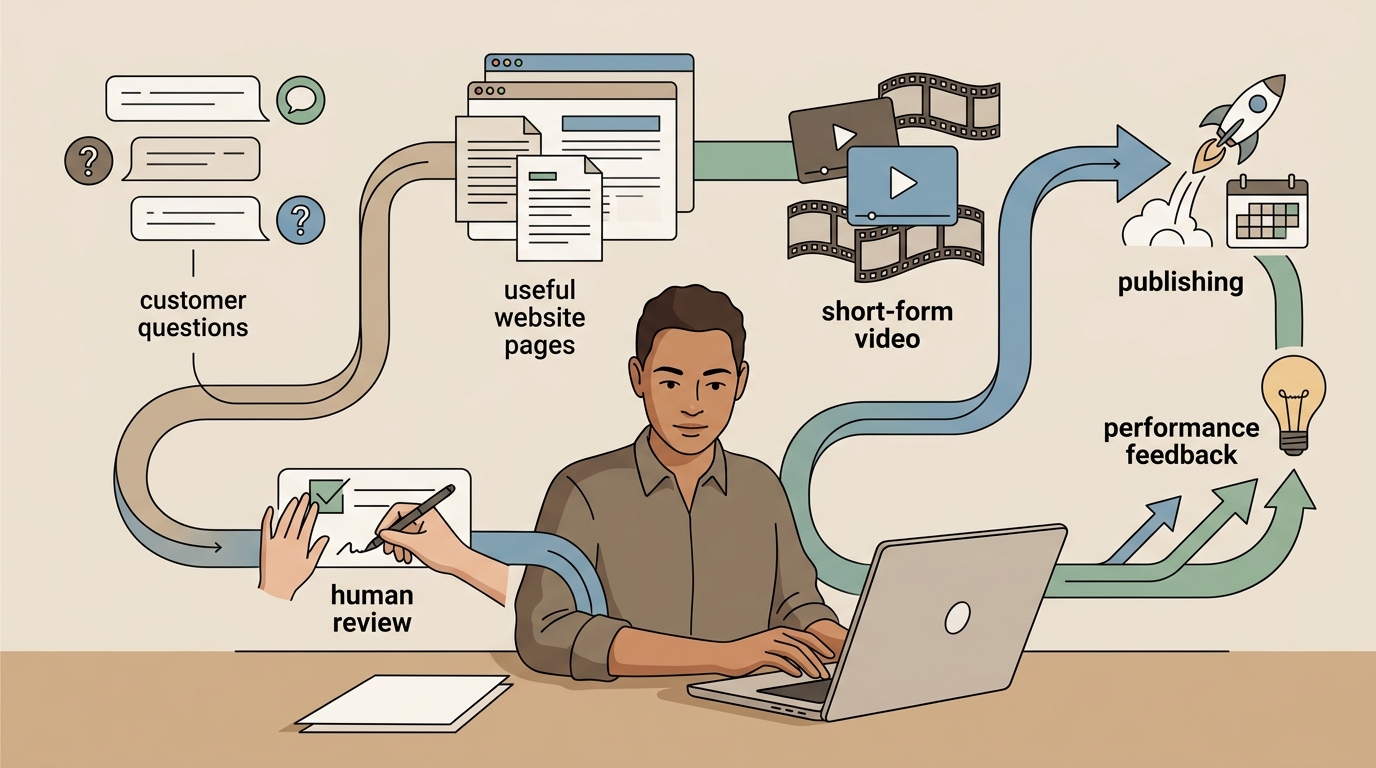
A more manageable workflow looks like this:
- Research one customer question. Collect the original sources, qualifications, and related questions.
- Publish a durable answer page. Make this the primary reference rather than placing the complete explanation only in a social post.
- Develop several short-form angles. Turn parts of the answer into demonstrations, objections, comparisons, or practical tips.
- Review each output in context. A claim that works in a detailed article may become misleading when compressed into a 20-second script.
- Publish with a clear connection to the source. Direct interested viewers to the deeper resource when appropriate.
- Collect performance signals. Look at search impressions, visits, watch behavior, saves, comments, conversions, and recurring audience questions.
- Update the source page. Improve weak sections and add answers to useful questions uncovered during distribution.
The value of this sequence is continuity. Social content can test framing and earn attention, while the website holds the fuller explanation. Performance data then gives the next revision somewhere to start.
MG Social Studio is designed to support this kind of integrated workflow across research, blog creation, short-form video, publishing, and Growth Copilot recommendations. The point is to reduce avoidable handoffs while keeping the user in control.
Use AI to assist production, not bypass review
Google’s spam policies prohibit scaled content abuse, which it defines around producing many pages primarily to manipulate search rankings rather than help users. The policy can apply whether content is created by automation, people, or a combination of both (Google Search Central).
The distinction is purpose and value, not simply the presence of AI.
A sensible human review should cover more than grammar. Check:
- Names, dates, numbers, and product capabilities
- Links and source relevance
- Whether examples are real or merely plausible
- Whether the title promises more than the page delivers
- Claims that require legal, financial, health, or technical expertise
- Image labels, captions, and alternative text
- Calls to action and destination URLs
- Structured data and other metadata
For video, also review pronunciation, captions, visual continuity, timing, logos, product representations, and any synthetic person or voice. A polished render can still communicate the wrong fact.
Automation is most useful when it removes repetitive production steps while leaving consequential decisions visible to the person responsible for publishing.
Measure visibility without overcomplicating it
A small team can begin with a spreadsheet and existing analytics. You do not need an enterprise monitoring platform on day one.
Create a monthly prompt set based on the decision questions identified earlier. Record:
| Field | What to capture |
|---|---|
| Prompt | The exact question tested |
| Platform | Where the question was asked |
| Date | When the check occurred |
| Brand present | Whether the brand appeared |
| Linked or cited | Whether the answer included a source link |
| Description accuracy | Correct, incomplete, or incorrect |
| Competitors present | Other brands included in the answer |
| Source pages | Pages used or cited by the system |
| Action | Content or positioning change to consider |
AI answers can vary, so an isolated result should not be treated as a permanent ranking. Use a consistent prompt set and look for patterns over time.
Combine that review with business metrics:
- Search impressions and clicks to priority pages
- Referral visits that can be identified in analytics
- Branded search interest
- Demo requests, leads, subscriptions, or sales
- Assisted conversions where available
- Questions mentioned by new customers
- Content production and review time
Google reports traffic from its AI features within the Search Console Performance report under the Web search type rather than as a separate AI feature report (Google Search Central). Search Console can therefore help assess page-level performance, but it does not provide a complete cross-platform AI visibility score.
The metric that matters most depends on the business. A creator may value qualified subscribers. A local company may care about calls and bookings. A software business may focus on trial starts or demos. Citation counts are useful diagnostic signals, not final business outcomes.
Common mistakes to avoid
Publishing a large volume of interchangeable pages
Changing a city, industry, or product name across otherwise identical AI-generated pages is unlikely to create meaningful value. It can also move a site toward the kind of search-first production covered by Google’s scaled content abuse policy.
Treating a special file or schema type as the solution
There is no special markup that guarantees inclusion in Google’s AI features. Accurate structured data and sound technical SEO can support understanding, but they cannot replace a useful page.
Tracking only your company name
A brand-name prompt shows whether a system knows the brand. It does not show whether the business appears during discovery. Track non-branded questions such as “best workflow for turning blog posts into short videos” alongside branded checks.
Optimizing for a mention that does not fit the offer
Appearing in broad prompts can look impressive while attracting people who will never buy, subscribe, or return. Favor questions closely connected to your audience and capabilities.
Allowing generated content to publish without accountability
The person or team operating the site remains responsible for what it publishes. Keep an approval step for factual claims, positioning, visuals, metadata, and links.
A focused 30-day plan
Week 1: Establish the baseline
Choose 15 to 30 customer questions. Identify the page that should answer each one, then test a selection across the AI search experiences relevant to your audience. Record visibility, competitors, citations, and inaccuracies.
Week 2: Improve priority pages
Select three pages tied to meaningful customer decisions. Add direct answers, stronger sourcing, clearer author or company information, descriptive internal links, and relevant examples. Remove unsupported claims and stale details.
Week 3: Repurpose with purpose
Turn each improved page into a small set of social assets. A comparison section may become a short video. A checklist may become a carousel. A common mistake may become a demonstration. Keep the original page as the complete reference.
Week 4: Review and refine
Check indexing, Search Console performance, identifiable referrals, social engagement, and conversions. Repeat the prompt sample. Record what changed, but avoid attributing every movement to one edit.
Use the results to choose the next small set of pages or questions. That keeps the work tied to evidence instead of turning it into a one-time optimization exercise.
The practical advantage for lean teams
AI search creates another place where customers can encounter a business, but it does not remove the need for a credible website, focused positioning, or careful publishing.
Creators and small teams can often connect research, subject expertise, production, and customer feedback more closely than a large organization. The challenge is preserving that connection as output increases.
A workflow that connects durable website content with short-form video and social distribution can help. Each asset has a defined role, evidence stays attached to claims, and audience questions can guide the next piece of work.
If you want to bring research, creation, publishing, and performance-informed recommendations into a more connected process, start creating with MG Social Studio.
Results vary. AI-generated recommendations and content should be reviewed before publishing.
Frequently asked questions
What is AI search visibility?
AI search visibility describes whether and how a brand, person, product, or website appears in AI-generated search answers. It can include source links, citations, recommendations, summaries, and unlinked mentions.
Is generative engine optimization different from SEO?
Generative engine optimization, often shortened to GEO, focuses on visibility inside AI-generated answers. Many of its useful practices overlap with SEO, including accessible pages, clear writing, factual support, internal links, and demonstrated expertise. Google says its usual Search fundamentals also apply to its AI features.
Do I need special schema for AI search?
No special schema is required for Google’s AI features. Use structured data only when it accurately represents visible content and follows the applicable search guidelines.
Can AI-generated content rank in search?
Google’s guidance focuses on the quality and purpose of content rather than banning AI assistance. Using automation primarily to manipulate rankings or mass-produce low-value pages can violate its spam policies. Human review and genuine usefulness remain important.
How can a small business track AI visibility?
Begin with a fixed set of high-intent customer questions. Check them periodically on relevant platforms and record brand mentions, citations, competitors, description accuracy, and linked sources. Compare those observations with Search Console, analytics, and conversion data.
How often should AI visibility be reviewed?
A monthly review is a practical starting point for most lean teams. More frequent checks may be useful during a launch or major content update, but daily fluctuations can be noisy and should not automatically trigger strategy changes.