
AI video governance
AI Video Copyright, Commercial Licensing, and Disclosure Rules: A Practical Guide
Can you use AI-generated video commercially, copyright the result, and publish it without an AI label? This guide separates copyright, platform licenses, third-party rights, and disclosure obligations so creators and small businesses can make safer decisions.
By MillsGuild Editorial ·
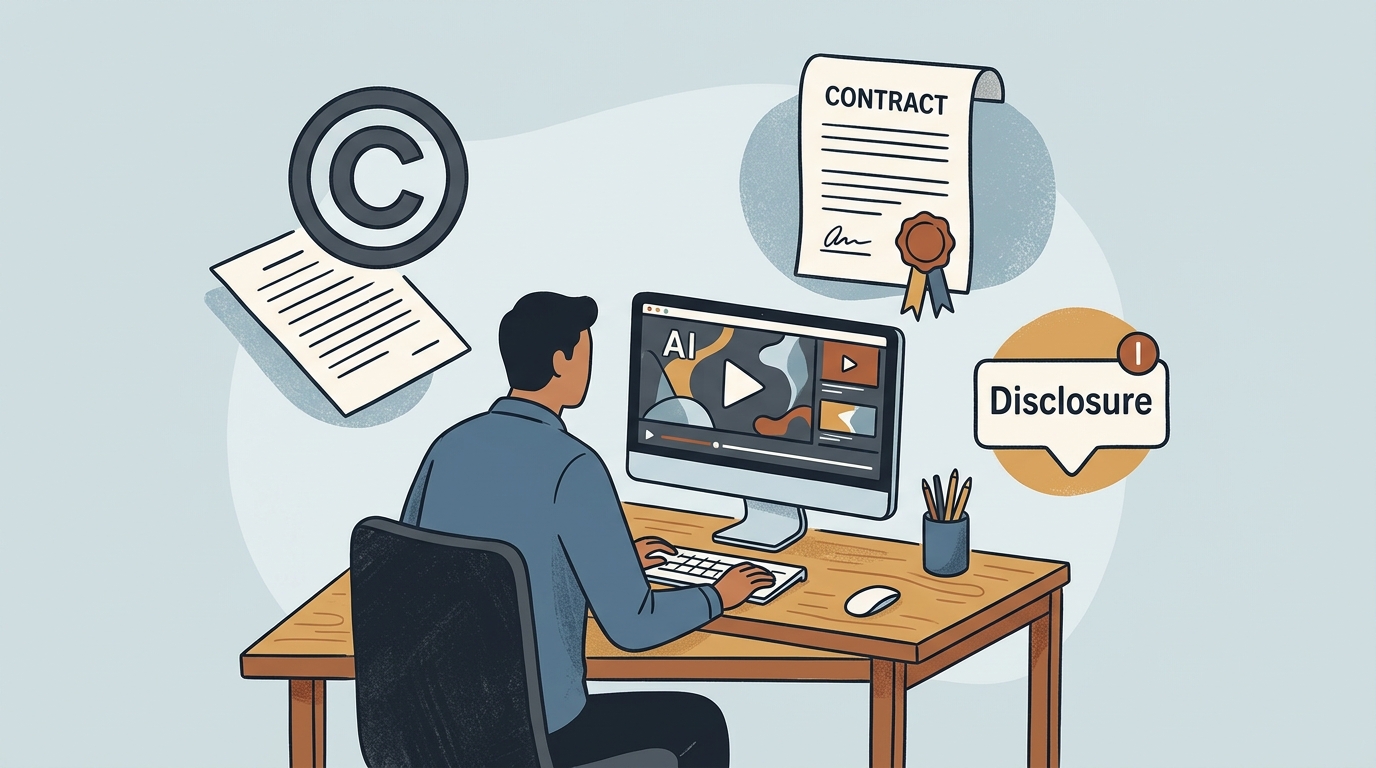
AI Video Copyright, Commercial Licensing, and Disclosure Rules
You can often use an AI-generated video in a commercial campaign, but that does not necessarily mean you own copyright in every frame. It also does not clear the video of music, trademark, likeness, advertising, or platform-policy concerns.
A tool may grant commercial use under its subscription terms while United States copyright law protects only the human-authored portions of the finished work. A paid plan may let you monetize an output, but it generally will not clear an unauthorized celebrity likeness or copyrighted song. An AI disclosure label may satisfy a platform policy, but it will not make a misleading product demonstration lawful.
This guide separates those issues and provides a review process for creators, marketers, agencies, and small businesses. It focuses mainly on the United States, with a note about the European Union. It is general information, not legal advice.
The short answer
Before publishing an AI-assisted video commercially, ask:
- Does the tool license this output for commercial use? Check the terms that applied to your plan and account when the asset was generated.
- Which parts of the finished video can receive copyright protection? In the United States, copyright requires human authorship. Purely AI-generated material may not qualify, while original scripts, narration, editing, and creative arrangement may.
- Did you clear third-party rights? A tool's commercial license usually does not grant rights to someone else's music, footage, character, logo, face, or voice.
- Must the synthetic content be disclosed? The answer depends on the jurisdiction, how realistic or potentially misleading the content is, and the rules of the platform where it will appear.
These are related questions, but they are not one ownership question.
Commercial permission is not the same as copyright ownership
A commercial license answers a contractual question: does the AI provider allow you to use an output in advertising, client work, monetized content, or another revenue-generating activity?
Copyright answers a different question: does the law recognize protectable human expression in the work, and can its owner prevent unauthorized copying of that expression?
A vendor can give you contractual permission to use an output. It cannot create copyright protection where copyright law does not recognize authorship.
For example:
- You may have permission to place an AI-generated clip in a paid advertisement.
- The raw clip itself may contain little or no copyrightable human authorship.
- The complete advertisement may still contain protectable human-created elements, such as an original script, narration, graphics, selection of shots, pacing, and editing.
Commercial usability and legal exclusivity are separate issues.
Who owns the copyright in an AI-generated video?
The United States Copyright Office maintains that copyright protects material created by human beings. Its report on copyrightability explains that prompts alone generally do not provide enough control over expressive details to make the user the author of resulting AI material.
That does not make every AI-assisted project unprotectable. The Copyright Office evaluates which portions contain human authorship.
For example, consider two workflows.
Workflow A: Generate and upload
A creator enters a short prompt, accepts the first video, and posts the unedited file.
The user may have commercial permission under the tool's terms. However, the generated visual material may lack the human authorship necessary for United States copyright protection.
Workflow B: Build a human-directed production
A creator writes an original script, records narration, generates several visual options, rejects unsuitable clips, selects particular shots, edits their timing, designs graphics, and arranges everything into a deliberate sequence.
The creator may be able to claim copyright in the original script, narration, graphics, editing, and creative arrangement, even if the underlying AI-generated footage must be excluded from the claim.
The Copyright Office's registration guidance for works containing AI-generated material says applicants should disclose AI-generated content and describe the human-authored material being claimed. A registration should not claim more than the applicant actually created.
Human review is not automatically human authorship
Clicking approve, correcting a typo, or choosing one result from a few outputs does not automatically make the generated material copyrightable. The relevant issue is whether a person contributed original expression, not whether a person participated somewhere in the workflow.
Meaningful contributions may include:
- Writing an original script or storyboard
- Recording original narration or footage
- Designing original graphics and animation
- Making creative editing and sequencing decisions
- Substantially modifying generated material through human-controlled work
There is no universal percentage of human involvement that guarantees protection. Copyrightability is fact-specific.
How to evaluate an AI video tool's commercial license
Terms can differ by plan, product, region, model, and generation date. They can also change. Avoid relying on a comparison article or a pricing-page badge as your only record.
Review the actual terms associated with the account that generated the output. Providers such as HeyGen, Luma AI, and Pika publish their own terms, but the relevant wording must still be matched to the plan and date of use.
Look for these issues before using an output commercially.
1. Is commercial use allowed on your plan?
Free and trial plans may carry different restrictions from paid plans. Do not assume removing a watermark means commercial use is permitted.
Likewise, do not assume that upgrading later changes the rights attached to an asset generated earlier. If the terms tie commercial rights to generation during an active paid subscription, regenerate the final asset after upgrading and retain the invoice.
2. What does the provider mean by ownership?
A provider may say that users own their outputs or that the provider assigns its rights to the user. Read that language in context.
Such a clause may allocate contractual rights between you and the provider. It does not guarantee that the output qualifies for copyright protection, that it is unique, or that it does not resemble protected third-party material.
3. Can the provider reuse your content?
Check the licenses covering your prompts, uploads, voice recordings, source footage, avatars, and outputs. Determine whether the provider may use that material to operate, improve, market, or train its services.
For confidential launches or client projects, also review retention, deletion, opt-out, and enterprise privacy provisions. A commercial-use license does not automatically make a service suitable for confidential material.
4. Are client and agency uses covered?
Agencies should confirm whether the provider permits client work and what rights, if any, can be assigned or sublicensed. The client agreement should explain which party is responsible for source materials, likeness consent, factual claims, and platform disclosures.
5. What happens after cancellation?
Check whether existing outputs remain commercially usable after the subscription ends. Save the relevant terms rather than assuming they will remain online in the same form.
A paid plan does not clear third-party rights
The commercial license for an AI tool usually addresses the relationship between the provider and the user. It does not give you rights to material owned by other people.
AI video production can touch several rights at once:
- Copyright in music, photographs, film clips, illustrations, and scripts
- Trademark rights in brand names, packaging, and logos
- Publicity and privacy rights involving a person's face, voice, name, or identity
- Contractual restrictions attached to stock assets and uploaded files
- Advertising laws governing claims, demonstrations, and endorsements
If you upload a copyrighted song to animate a clip, paying for the video generator does not license the song. If you prompt for a famous character, the subscription does not transfer the character owner's rights. If an avatar resembles a celebrity, an AI label does not provide consent.
Be careful with inputs as well as outputs
Risk does not begin only after generation. Uploading source footage, customer photos, employee recordings, or voice samples may itself require permission.
Before using an input, document:
- Where it came from
- Who owns it
- What license or consent covers it
- Whether that permission includes AI processing and commercial publication
- Whether there are limits on duration, territory, media, or campaign type
For stock assets, read the applicable license and confirm whether it permits the intended modification, AI processing, and publication. Do not assume those uses are covered.
Voice cloning and AI avatars require documented consent
A voice is not necessarily protected by copyright in the same way as a recording or script, but unauthorized imitation can still create publicity, privacy, false endorsement, fraud, and platform-policy problems.
Do not clone a real person's voice or create a realistic digital replica without clear permission.
Consent should identify the approved uses rather than relying on a vague release. Depending on the project, it may address:
- The voice, face, or source recordings covered
- The tools or vendors permitted to process them
- Whether use includes paid advertising and client work
- Where and for how long the replica may appear
- Whether new scripts can be generated later
- How consent can be withdrawn
- What happens to stored model and training data
A creator cloning their own voice has fewer consent issues, but businesses should still retain records showing who authorized the corporate use. This matters when contractors, agencies, employees, or acquired brands are involved.
Disclosure is not a substitute for consent. Labeling an unauthorized celebrity replica as AI-generated does not make the use authorized.
When must AI-generated video be disclosed?
There is no single global rule requiring every AI-assisted edit to carry the same label. Disclosure depends on the content, jurisdiction, context, and distribution platform.
A useful starting point is to ask whether a reasonable viewer could be misled about who appeared, what happened, or what a product can do.
FTC rules focus on deception, not the novelty of the tool
The United States Federal Trade Commission can apply existing consumer-protection law to AI marketing. Its Operation AI Comply announcement focused on deceptive claims involving AI products and AI-enabled business opportunities.
For an advertiser, the core issue is whether the overall message is truthful, supported, and non-deceptive.
Suppose an AI-generated product demonstration shows a stain remover producing a result the actual product cannot achieve. Adding a small AI-generated label does not fix the unsupported performance claim. The misleading demonstration remains the problem.
The same principle applies when an AI avatar appears to be a customer, expert, or employee who never gave the endorsement. Disclosure may provide context, but it does not automatically cure a fabricated testimonial or false implication.
European Union transparency obligations are broader
Article 50 of the European Union AI Act contains transparency obligations for certain synthetic content and deepfakes. Relevant provisions are scheduled to apply on August 2, 2026.
The precise duty depends on whether the organization is providing an AI system or deploying its output. The regulation also includes qualifications for artistic, satirical, fictional, and similar works.
Businesses distributing realistic synthetic media to European audiences should obtain jurisdiction-specific advice before the rules apply. A platform label alone may not address every obligation.
Platforms impose their own rules
Social platforms can require disclosure even when a particular use is not covered by a general disclosure statute. Their requirements differ and may change, so check the current policy for each destination before publication.
For example, YouTube requires creators to disclose meaningfully altered or synthetic content when it appears realistic and could mislead viewers about a real person, place, scene, or event. Clearly unrealistic animation and minor production assistance are treated differently from realistic synthetic depictions.
Do not assume that a setting used for YouTube also satisfies the requirements of another service. Review the applicable policy for each destination, including any disclosure controls for the specific format or audience.
Four examples that show how the rules interact
AI-generated abstract background footage
A business generates a non-realistic animated background for a social post and adds an original script, narration, and graphics.
Commercial use depends on the generator's terms. The human-authored script, narration, graphics, and arrangement may be copyrightable. Disclosure may not always be required, but the business should still check the destination platform.
A realistic avatar of the founder
A founder authorizes an avatar and voice model to present a product update.
The business should retain the founder's consent, follow the tool's avatar rules, verify the script, and use the platform's synthetic-media disclosure when required. If the video makes product claims, those claims still need support.
An AI celebrity endorsement
A marketer generates a recognizable actor praising a product and labels the clip as AI-generated.
The label does not solve the lack of consent, possible false endorsement, or likeness issues. A commercial license from the generator does not authorize the celebrity's identity.
A fictional product demonstration
An AI video depicts a real product accomplishing something it cannot reliably do.
Even if the visuals are licensed and disclosed, the advertisement may still be deceptive. The business must review what the video communicates, not merely how it was produced.
A safer commercial AI video workflow
Legal review will not fit every social post, but every team can use a repeatable rights and disclosure process.
Before generation
- Choose a plan that permits the intended commercial use.
- Save the applicable terms, plan description, and invoice.
- Confirm that uploaded images, music, footage, and recordings are cleared.
- Obtain written consent for real faces, voices, and digital replicas.
- Avoid prompts that intentionally reproduce a protected character, celebrity likeness, brand, or other recognizable third-party material without permission.
During production
- Keep the original human-written brief, script, and storyboard.
- Record which tool and account generated each material asset.
- Save generation dates and raw outputs for important projects.
- Make deliberate human editing, selection, narration, and design decisions.
- Review outputs for accidental logos, recognizable people, copied-looking characters, and false visual claims.
Before publication
- Verify every objective product or performance claim.
- Check the current disclosure policy for each destination platform.
- Apply required altered-content or AI labels.
- Confirm that the final render was produced under the correct commercial plan.
- Save the approved file, consent records, licenses, and publication details together.
This documentation does not guarantee that a work is copyrightable or free of disputes. It does make it easier to understand what was created, licensed, approved, and published.
What to save in your project record
For significant campaigns and reusable brand assets, retain:
- The creative brief and human-authored scripts
- Storyboards, timelines, and edit files
- Raw AI outputs and selected versions
- Tool name, model, account, plan, and generation date
- A copy or screenshot of the applicable commercial terms
- Subscription invoices
- Music, footage, font, and stock licenses
- Avatar and voice consent forms
- Claim substantiation and product documentation
- Platform disclosure selections
- Final approval and publication records
A centralized content workflow can reduce the chance that these records end up scattered across email, cloud drives, and several AI tools. MG Social Studio supports AI-assisted creation, research, publishing workflows, and Growth Copilot recommendations while keeping human review part of the process. It does not replace rights clearance or legal review.
Start creating with MG Social Studio.
Results vary. AI-generated recommendations and content should be reviewed before publishing.
Frequently asked questions
Can I use AI-generated videos for commercial purposes?
Often, but only if the tool's terms permit your intended use under the plan that applied when the video was generated. You must also clear third-party material, likenesses, music, and advertising claims separately.
Does paying for an AI video tool give me copyright?
No. A paid plan can provide contractual commercial-use rights, but United States copyright protection still depends on human authorship. Protectable human elements may include original scripts, narration, graphics, editing, and creative arrangement.
Can I copyright a video made partly with AI?
Potentially. The Copyright Office may recognize the human-authored parts of a mixed work. Applicants should disclose AI-generated material and limit the claim to the qualifying human contributions.
Do I need to label every AI-generated video?
Not necessarily. Requirements vary by jurisdiction, platform, realism, and context. Realistic synthetic depictions of people or events are more likely to trigger disclosure rules than clearly fictional animation or minor production assistance.
Can I use a celebrity's AI voice if I disclose it?
Disclosure does not provide consent. An unauthorized voice or likeness can still create publicity, privacy, false endorsement, and platform-policy risks.
Can I generate a draft on a free plan and upgrade before publishing it?
Do not assume an upgrade applies retroactively. Check the terms that governed the account when the asset was generated. If commercial rights attach only to paid-plan generations, regenerate the final asset while the qualifying subscription is active.
Sources
- United States Copyright Office, Copyright and Artificial Intelligence
- United States Copyright Office, Registration Guidance for Works Containing AI-Generated Material
- Federal Trade Commission, Operation AI Comply
- European Union, Regulation 2024/1689, Artificial Intelligence Act
- YouTube Help, Disclosing Use of Altered or Synthetic Content
- HeyGen Terms
- Luma AI Terms
- Pika Terms
Sources
- https://www.copyright.gov/ai/
- https://www.copyright.gov/ai/ai_policy_guidance.pdf
- https://www.ftc.gov/news-events/news/press-releases/2024/09/ftc-announces-crackdown-deceptive-ai-claims-schemes
- https://eur-lex.europa.eu/eli/reg/2024/1689/oj
- https://support.google.com/youtube/answer/14328491
- https://www.heygen.com/terms
- https://lumalabs.ai/capture/terms-of-service
- https://pika.art/terms-of-service