
Brand governance
How to Train AI on Your Brand Voice: A Practical Small Business Guide
Build a reusable AI brand voice system with clear rules, real examples, testing criteria, and human review. This practical guide covers written content, short-form video, social media automation, privacy, and continuous improvement.
By MillsGuild Editorial ·
How to Train AI on Your Brand Voice: A Practical Small Business Guide
AI can produce a usable draft in seconds, but speed does not make the draft sound like your business. The reliable way to get closer to your brand voice is to give the tool specific rules, strong examples, clear boundaries, and a review process that improves over time.
A prompt such as “write in a friendly, professional voice” leaves too much room for interpretation. One model may choose conversational language. Another may add emojis, exclamation points, or exaggerated enthusiasm.
A useful brand voice system describes observable behavior. It explains how your brand sounds, what it avoids, how tone changes by situation, which claims need evidence, and what an acceptable draft should contain.
This guide shows you how to build that system for blog posts, social content, email, and AI-generated video scripts.
What does it mean to train AI on your brand voice?
Here, “training” means supplying brand context that an AI tool can use repeatedly. That context can live in custom instructions, a project workspace, an uploaded knowledge file, a reusable prompt, or a specialized content platform.
A practical AI brand voice system has four parts:
- Voice rules: The stable characteristics of how your business communicates.
- Approved examples: Real writing that represents the voice well.
- Boundaries: Phrases, habits, claims, and tones the AI should avoid.
- Review criteria: A consistent way to decide whether an output is ready.
The AI still needs a brief for each assignment. Your voice system describes how the brand should communicate while the tool completes a specific task.
Start with real content, not aspirational adjectives
The best training material usually already exists in your business. Look for content that sounds natural, communicates clearly, and represents how you want customers to perceive the brand.
Useful source material can include:
- Founder-written emails
- High-quality blog posts
- Product pages that required little editing
- Video transcripts
- Customer support responses
- Social posts that accurately reflect the business
- Sales materials approved by the people responsible for the brand
Choose a small, clean collection rather than uploading everything you have. Five to ten strong samples are a practical starting point. A mixed archive containing outdated copy, legal boilerplate, weak freelance drafts, and unrelated campaign styles can teach conflicting patterns.
Remove sensitive customer information, internal financial data, private contracts, passwords, and confidential strategy before uploading anything.
Annotate why each sample works
Examples become more useful when you explain what the AI should notice.
Instead of uploading a social post without context, add a note such as:
This example opens with the customer's problem rather than a product claim. It uses short sentences, avoids exaggerated language, and ends with one practical next step.
Annotations help separate the underlying voice from accidental details. Without them, the AI may imitate surface features such as paragraph length or punctuation while missing the reasoning that made the original effective.
Turn your voice into behavioral instructions
Words such as “authentic,” “bold,” and “professional” can be useful in a brand workshop, but they are difficult for an AI system to apply consistently. Translate each trait into visible behavior.
| Vague trait | More useful AI instruction |
|---|---|
| Friendly | Address the reader directly, use familiar words, and explain technical terms without talking down to the audience. |
| Confident | Make clear recommendations when evidence supports them. Do not use absolute promises or present uncertain information as settled. |
| Witty | Use occasional understated humor. Avoid sarcasm, insults, or jokes during sensitive customer situations. |
| Professional | Use complete thoughts, specific language, and restrained punctuation. Avoid stiff corporate filler. |
| Direct | Put the recommendation near the beginning. Keep necessary context and avoid sounding dismissive. |
Boundaries make these instructions clearer. “Confident, never arrogant” gives the AI a useful limit. “Conversational, but not overly casual” is more precise than “conversational” alone.
Separate voice from tone
Your brand voice should remain recognizable across channels. Tone changes with the reader's situation.
A billing notice should have a different emotional setting from a celebratory product launch. A short educational video can be energetic while a serious support message remains measured.
Add a simple tone matrix to your instructions:
| Situation | Tone adjustment |
|---|---|
| Educational article | Patient, clear, and specific |
| Short-form video | Concise, energetic, and spoken naturally |
| Product announcement | Positive but factual |
| Customer problem | Calm, empathetic, and solution-focused |
| Correction or apology | Direct, accountable, and free of promotional language |
This helps prevent one emotional setting from being applied to every message.
Create a one-page AI brand voice card
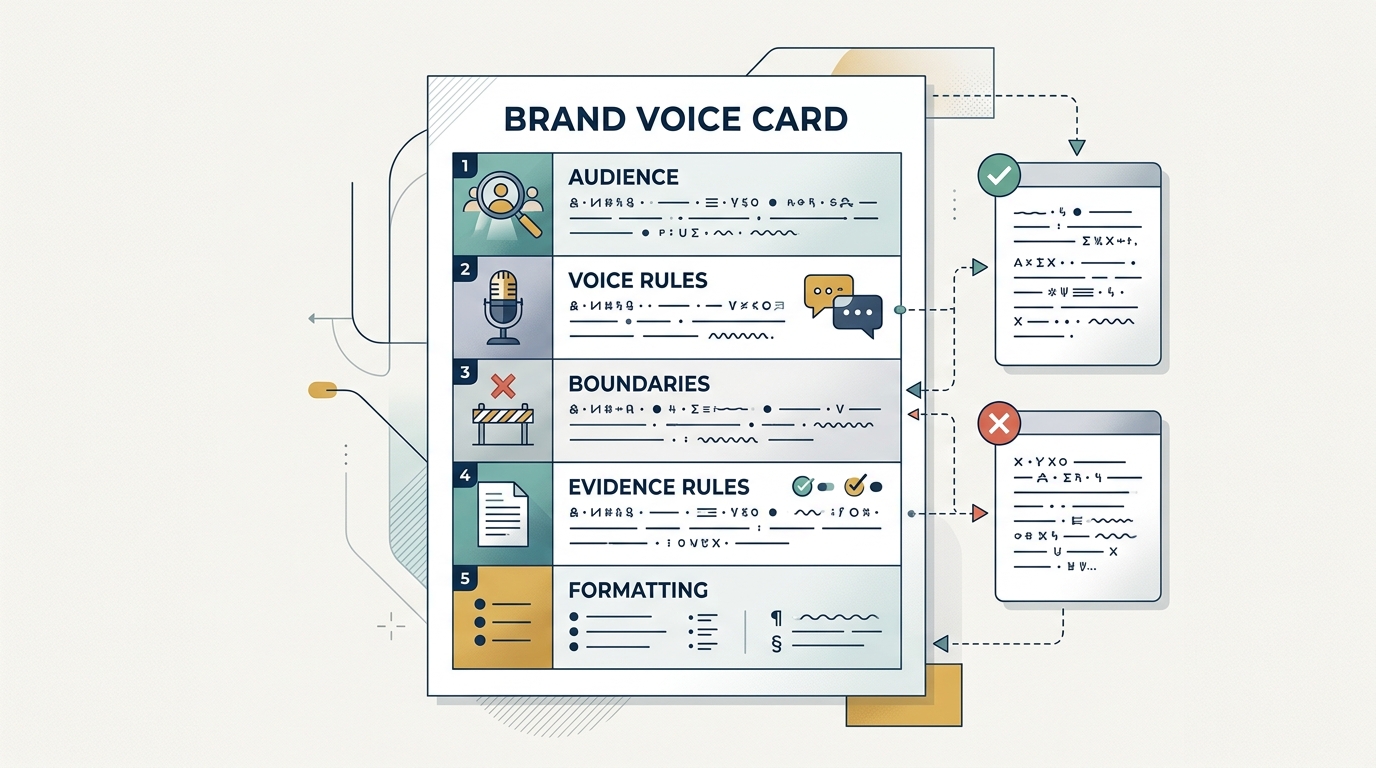
Your first version does not need to be a large brand manual. A concise voice card is easier to update and more likely to be used consistently.
Include the following sections.
Brand and audience
Explain what the business does, who it serves, and what the audience is trying to accomplish.
Example:
We provide bookkeeping support for independent consultants and small agencies. Our readers understand their businesses but may not understand accounting terminology. They want clear decisions and fewer administrative surprises.
Core voice rules
Write rules the AI can observe in its own output.
Example:
- Lead with the practical answer.
- Prefer concrete examples to abstract claims.
- Explain specialized terms on first use.
- Vary sentence length naturally.
- Use contractions when they improve the flow.
- Address the reader as “you.”
- Acknowledge meaningful limitations.
Prohibited patterns
List the language that repeatedly creates off-brand results.
This may include:
- Unsupported superlatives such as “best,” “ultimate,” or “revolutionary”
- Promises of guaranteed growth or results
- Empty openings about a changing digital landscape
- Excessive exclamation points
- Fake urgency
- Invented quotes, statistics, or customer stories
- Corporate filler such as “leverage synergies”
Keep the banned list focused. If it becomes too broad, the AI may produce awkward prose while trying to avoid ordinary words.
Product and evidence rules
State which claims the AI may make and which ones require verification.
For example:
- Do not invent prices, performance figures, features, integrations, or customer results.
- Use current product documentation for feature claims.
- Mark uncertain information for review instead of filling the gap.
- Do not imply guaranteed rankings, views, revenue, or virality.
These are governance rules as well as style preferences. They reduce the chance that polished copy will hide an unsupported claim.
Formatting preferences
Specify only the conventions that matter. You might define paragraph length, heading style, preferred calls to action, capitalization, spelling variant, and whether emojis are appropriate.
Build a reusable brand voice prompt
Once the voice card is ready, convert it into a reusable instruction block. Store it in your tool's persistent workspace if that option is available. Otherwise, keep a controlled master copy that team members can paste into new assignments.
Here is a starting template:
You are creating content for [BRAND].

Audience:
[Describe the reader, their knowledge, and their immediate problem.]

Core voice:
- [Observable voice rule]
- [Observable voice rule]
- [Observable voice rule]

Tone for this assignment:
[Describe the situation-specific tone.]

Always:
- Use concrete language and useful examples.
- Distinguish verified facts from assumptions.
- Flag claims that require confirmation.
- Preserve the meaning of approved product terminology.

Never:
- Invent statistics, quotations, testimonials, features, or results.
- Promise guaranteed outcomes.
- Use the following phrases or patterns: [LIST].

Reference examples:
[Paste or attach approved examples with annotations.]

Assignment:
[State the channel, topic, reader goal, length, and call to action.]

Before returning the draft, check it against every rule above and identify any factual claims that need human verification.
The assignment still needs detail. “Write an Instagram post about our service” is too open-ended. Include the intended reader, the specific problem, the desired action, the format, and the source material the AI may use.
Use examples and counterexamples together
An approved example shows the AI what success looks like. A counterexample clarifies the boundary.
Suppose your brand sells practical marketing software.
Weak version:
Revolutionize your content strategy and unlock limitless growth with our game-changing AI solution!
Improved version:
Turn a researched topic into a draft, short-form video, and publishing workflow without moving the project through several disconnected tools.
The second version is more specific and avoids promising an outcome the software cannot guarantee. When you save the pair, explain why one is rejected and the other is approved.
Counterexamples should come from recurring mistakes, not deliberately absurd writing. Useful categories include:
- Too promotional
- Too formal
- Too vague
- Too many claims
- Wrong tone for the situation
- Accurate message expressed in off-brand language
Test the system before automating it
A brand voice prompt can work on one assignment and fail on another. Test it across the content you actually produce.
A useful test set might include:
- A 30-second educational video script
- A product announcement
- A customer support response
- A LinkedIn post
- An email subject line and body
- A short blog introduction
- A correction to a previously published claim
Review each output against a simple rubric:
| Criterion | Review question |
|---|---|
| Voice match | Does this sound recognizably like the approved examples? |
| Audience fit | Does it assume the right level of knowledge? |
| Specificity | Does it use concrete details rather than generic claims? |
| Factual safety | Are claims supported, sourced, or clearly flagged? |
| Tone | Is the emotional setting right for the situation? |
| Usability | Could an editor approve this with limited changes? |
This rubric is an internal editorial tool, not a scientific score. Its purpose is to make feedback consistent.
When a draft fails, revise the instruction that allowed the failure. Avoid fixing the same symptom by hand on every draft.
For example, if every video begins with a loud rhetorical question, add a rule such as:
Use a direct problem statement, surprising verified detail, or specific outcome as the opening. Do not default to rhetorical questions.
Adapt the voice for AI video
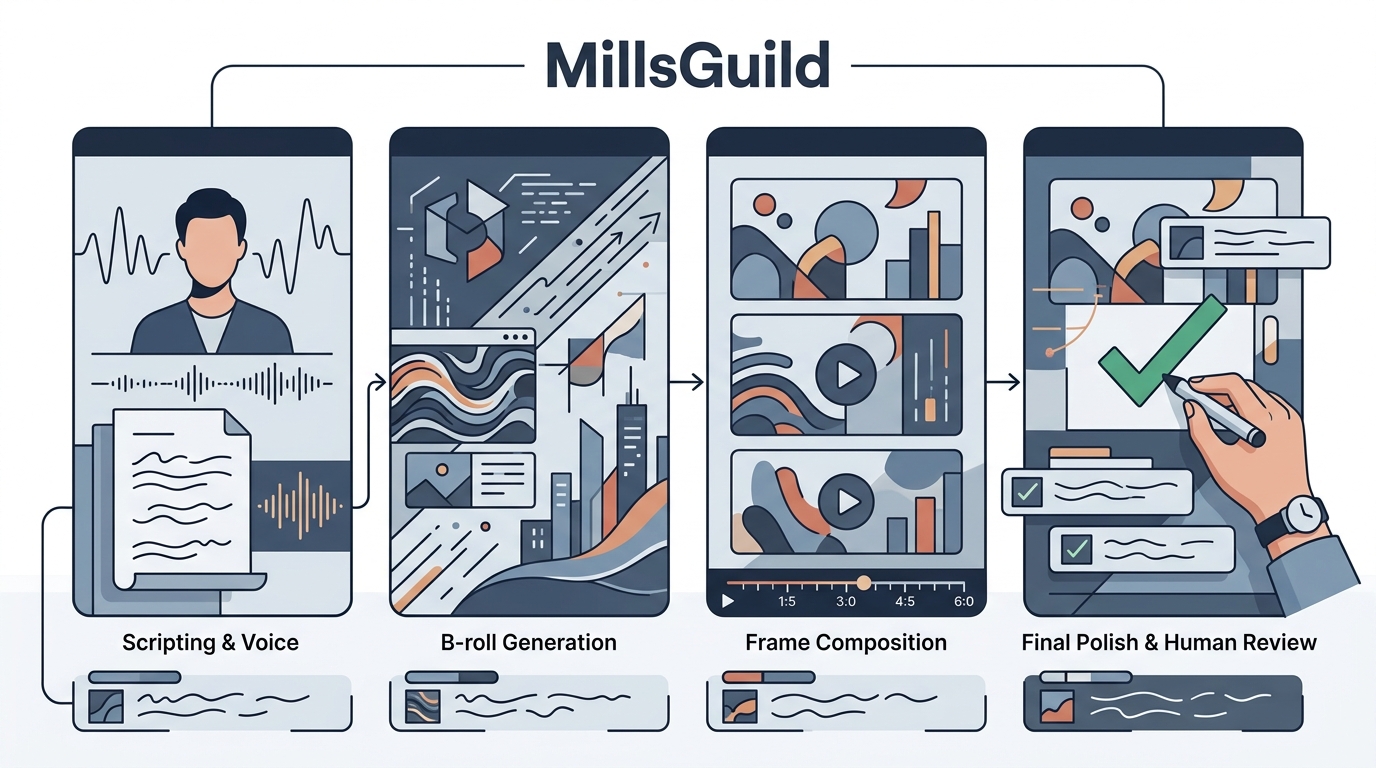
Brand voice in video involves more than the script. Spoken rhythm, visuals, captions, presenter style, and the call to action all affect how the brand feels.
Add video-specific instructions to your voice system.
Write for speech
A blog sentence may be grammatically correct but difficult to say aloud. Ask for short spoken phrases, natural contractions, and clear pauses. Read the script aloud before rendering the final video.
Define the hook style
Document the openings your brand will and will not use.
For example:
- Start with the practical problem or a useful observation.
- Avoid manufactured controversy.
- Do not promise a secret, hack, or guaranteed result.
- Make sure the opening matches what the video actually delivers.
Control visual tone
Specify visual boundaries separately from writing style. Include preferences for colors, typography, caption density, presenter use, B-roll, pacing, and imagery that should be avoided.
An understated financial advisory brand probably should not pair a calm script with frantic cuts and meme sound effects. A creator education brand may need more visual movement than its long-form articles.
Review the complete asset
A good script can still produce an off-brand video. Check pronunciation, caption accuracy, visual continuity, music level, on-screen claims, and whether the final call to action fits the content.
Treat video rendering as another draft and review it before publication.
Add brand voice to your social media automation workflow
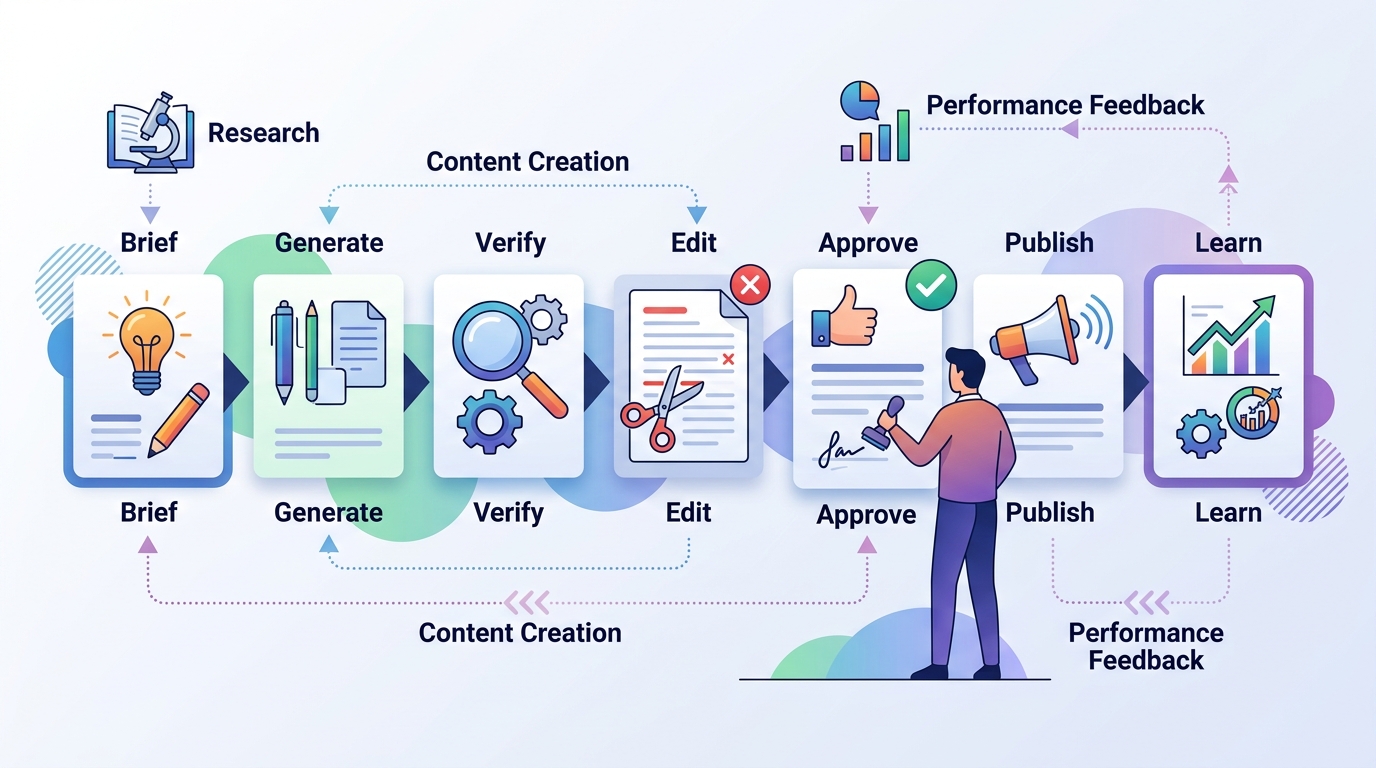
Automation works better when brand context enters at the beginning instead of being applied during final cleanup.
A controlled workflow looks like this:
- Brief: Define the audience, channel, topic, source material, and objective.
- Generate: Apply the approved voice card and channel-specific instructions.
- Verify: Check facts, product details, links, quotations, and claims.
- Edit: Fix voice, clarity, pacing, and platform fit.
- Approve: Require a designated person to approve publication.
- Publish or schedule: Send only the approved version to the publishing queue.
- Learn: Review performance and editorial corrections, then update the system when a pattern emerges.
Keep generation and approval separate. Giving an AI access to a publishing tool does not make its drafts reliable enough to post without review.
Measure more than content volume. Useful operational signals include:
- How often drafts pass review without a full rewrite
- Which voice rules are violated most often
- How much time editors spend correcting repeated problems
- Whether approved terminology remains consistent across channels
- Which topics and formats earn meaningful audience response
Performance data can inform future briefs, but it should not automatically rewrite your brand identity. A high-performing gimmick may still be a poor long-term fit.
Protect private information when building your system
A brand voice file rarely needs raw customer records, private messages, contracts, or confidential financial information. Use redacted examples whenever possible.
Data practices vary by provider and account type. OpenAI states that content submitted to individual services such as ChatGPT may be used to improve models unless the user changes the relevant data control or opts out. It separately states that data from its business products and API is not used for model training by default. Check the current policy and settings for the specific service and plan you use rather than assuming every account receives the same treatment.
Before uploading brand material:
- Remove personal and customer-identifying information.
- Confirm that you have permission to use the material.
- Review the provider's current training and retention settings.
- Restrict access to the workspace or custom assistant.
- Keep the authoritative voice guide outside the AI platform as a controlled company document.
If your workflow handles regulated or sensitive data, obtain appropriate legal and security advice before connecting it to an AI service.
Common mistakes that weaken AI brand voice
Uploading an entire website without curation
A website can contain multiple authors, old positioning, legal text, SEO pages, and campaign copy from different periods. Curate the strongest examples instead of assuming every page represents the desired voice.
Writing a long list of adjectives
“Warm, disruptive, authentic, premium, approachable, visionary” creates interpretation problems. Replace each important trait with a behavior and a boundary.
Treating all channels the same
Consistency does not require copying the same paragraph into a blog, email, LinkedIn post, and video script. Preserve the voice while adapting structure, pacing, and context.
Expecting the prompt to enforce factual accuracy
A voice guide can tell the AI not to invent information, but it cannot prove every statement is correct. Verify material claims against reliable sources and current product documentation.
Editing outputs without updating the system
If editors repeatedly remove the same opening, phrase, or claim, turn that correction into a new rule or counterexample. Otherwise, the team pays for the same mistake on every draft.
Automating publication too early
First establish that the system can produce acceptable drafts across several content types. Then automate low-risk handoffs while retaining approval controls.
Maintain a brand voice feedback loop
Your voice system should change when the business changes, but it should not shift every time one post performs well.
Review it when you introduce a new product, enter a new market, change positioning, add a major content channel, or notice repeated editing problems.
Keep a simple change log:
- What rule changed
- Why it changed
- Who approved it
- Which examples were added or removed
- Which workflows need the updated version
Version control matters when several people or tools generate content. Without one authoritative file, different workspaces can quietly use conflicting instructions.
Do you need fine-tuning?
Most small businesses should begin with instructions, examples, templates, and a review workflow. These are easier to update and usually sufficient for marketing drafts.
Fine-tuning may become relevant when a business has a large collection of clean training examples, a stable output format, technical resources, and a clear way to evaluate results. It will not remove the need for factual checks, privacy controls, or human approval.
If your current problem is generic wording, inconsistent briefs, or missing product context, improve the voice system before considering a more technical solution.
Put the voice system inside the content workflow
A polished prompt helps, but the larger benefit comes from connecting research, creation, review, publishing, and learning. That can reduce the manual work of moving copy and brand instructions between disconnected tools while keeping users in control.
MG Social Studio brings AI-assisted research, short-form video and blog creation, publishing workflows, and Growth Copilot recommendations into one environment. A structured brand voice process can guide creation, support review, and carry approved content into the next stage of the workflow.
Start creating with MG Social Studio
Results vary. AI-generated recommendations and content should be reviewed before publishing.
Frequently asked questions
Can AI learn my brand voice from my website?
It can use website copy as reference material, but an uncurated website may contain outdated or inconsistent writing. Select the strongest pages, remove irrelevant text, and explain why each example represents the desired voice.
How many writing samples should I provide?
Start with five to ten strong, varied examples. Quality and annotation matter more than uploading a large archive. Add examples only when they teach a useful pattern that is not already represented.
Should I create separate prompts for each social platform?
Keep one central voice guide, then add channel-specific instructions for format, pacing, audience context, and calls to action. This preserves the brand while allowing the content to fit each platform.
Can I fully automate social media posting with a brand voice prompt?
A voice prompt can improve drafting consistency, but it does not guarantee factual accuracy, good judgment, or correct timing. Automate repeatable production steps while retaining a human approval checkpoint before publication.
How do I know whether the AI matches my voice?
Create a fixed test set and review outputs against criteria such as voice match, audience fit, specificity, factual safety, tone, and editing effort. Track repeated corrections and convert them into clearer rules.
Should I ban common AI phrases?
Ban phrases and patterns that repeatedly create off-brand copy, but do not rely on a blacklist alone. Strong examples, concrete instructions, and human editing do more to improve the substance of the writing.