
AI search visibility
Information Gain SEO: How to Create Content AI Search Can Cite
Information gain comes from adding evidence, experience, data, or analysis that competing pages do not provide. Learn how to turn that difference into clear, verifiable content that search engines and AI answer systems can understand and cite.
By MillsGuild Editorial · · Updated
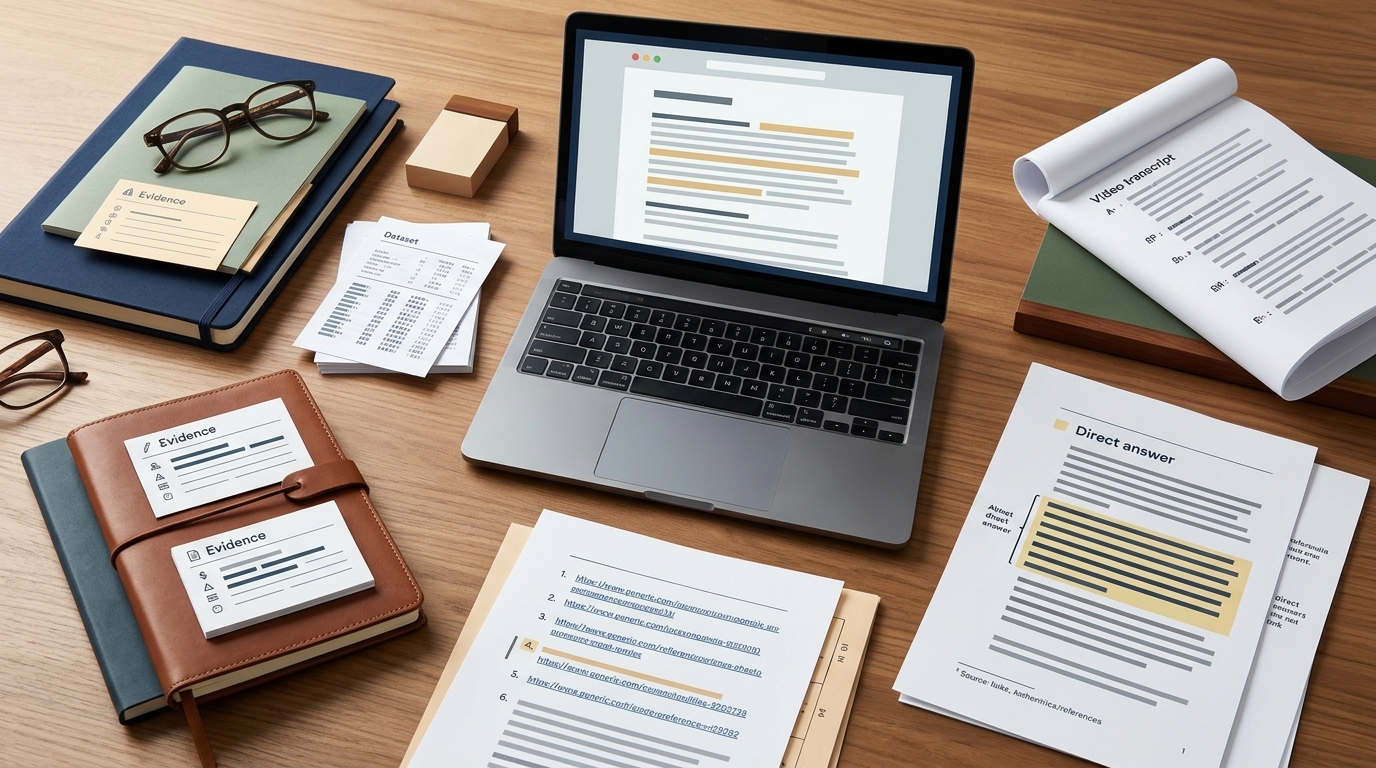
Information Gain SEO: How to Create Content AI Search Can Cite
AI can produce a polished summary of the first page of search results in seconds. That makes one editorial question more important than word count:
What does this page let a reader verify, understand, or do that a generic summary would not?
The answer might be a documented test, a first-party dataset, a product update checked on a specific date, or a decision rule developed through real work. That added value is the practical meaning of information gain SEO.
It can make a page more useful to readers and a stronger potential source for search and answer systems. It cannot guarantee a ranking or citation. The work still has to be accurate, accessible, and relevant to the question being asked.
What is information gain in SEO?
Information gain in SEO is the useful, relevant knowledge a page adds beyond what is already available to the searcher.
For a small business or creator, that might be:
- Results from a clearly described internal test
- First-party survey or customer-support data
- Screenshots showing how a process actually works
- A comparison based on disclosed criteria
- A decision framework developed through practical work
- An expert explanation of an edge case
- A correction supported by a primary source
- A current verification of information that has become outdated
The term is often connected to Google's Contextual Estimation of Link Information Gain. The patent describes estimating how much additional information a document may provide in a particular context, including in relation to documents a user has already seen.
A patent is not confirmation that Google uses a specific system exactly as described. It also does not give publishers a public information gain score. In editorial practice, the term is more useful as a question: what useful difference does this page contribute?
That question is actionable even when the underlying systems are not public.
What makes content citable by AI search?
Citable content gives a retrieval or answer system a passage it can identify and interpret. It also gives a human reader enough context to check the claim.
A useful passage generally includes:
- A specific question or claim. It addresses one identifiable issue.
- A direct answer. The conclusion appears before a long explanation.
- Supporting evidence. Data, documentation, screenshots, methodology, or a primary source supports the conclusion.
- Defined scope. The reader can see when, where, and to whom the answer applies.
- Clear attribution. The page identifies the author, organization, and external sources where relevant.
Compare these statements:
AI video tools save businesses time and improve content creation.
That claim is broad and difficult to verify. It could appear on almost any software marketing page.
A more useful passage would say:
We evaluated each AI video tool using the same 60-second script, 9:16 format, English voice requirement, and caption workflow. The comparison records rendering time, editing controls, export limitations, caption accuracy, and the plan tested. Testing was completed on [date], and the criteria are included so readers can repeat the evaluation.
The second passage defines a method. It does not claim a result that has not been shown. Once the test is conducted and the findings are published honestly, the page contains evidence that another writer cannot create by paraphrasing existing articles.
Information gain is not the same as being longer
A 4,000-word article can contain less new information than a 600-word field note. Extra length helps when a subject needs explanation. It adds little when it consists of repeated definitions, generic benefits, or loosely related questions.
Google's guidance for creating helpful, reliable, people-first content asks publishers to consider whether content offers original information, research, reporting, or analysis, and whether it provides substantial value compared with other pages in the results.
Before adding another section, ask:
- What will a reader learn here that competing pages do not show?
- Can the reader inspect the evidence?
- Did the author contribute experience or simply restate other sources?
- Is the page focused enough to resolve the query?
- Are limitations visible?
Information gain concerns the value of the difference, not the size of the document.
Use the CITE framework before you draft

The CITE framework helps a lean team decide whether an article has a defensible contribution before investing in production.
C: Contribution
State the new contribution in one sentence.
Examples:
- We will compare five tools using the same source video and disclosed criteria.
- We will analyze anonymized support questions from the previous quarter.
- We will document the workflow used to turn one expert interview into a video, article, and social campaign.
- We will verify which product features are available on entry-level plans as of a stated date.
If the contribution cannot be stated clearly, the article may still be useful, but its information gain is not yet defined.
I: Inspectable evidence
Decide what a skeptical reader should be able to inspect. Depending on the subject, that could include:
- A methodology section
- Original screenshots or recordings
- A downloadable template
- A sample size and collection period
- Source links beside factual claims
- An explanation of exclusions and failed attempts
- Product version, plan, device, or location details
A small transparent test is more credible than an unexplained claim about what always works.
T: Transparent boundaries
State what the evidence does and does not establish.
For example, a caption test using ten English-language clips recorded in a quiet room may help someone with similar material. It does not establish performance for every accent, language, microphone, or recording environment.
Boundaries keep a conclusion attached to the conditions that produced it. That context matters when a passage is quoted or summarized elsewhere.
E: Extractable presentation
Present the contribution in sections that make sense independently. Use descriptive headings, short answer-first paragraphs, labeled tables, explicit dates, and nearby source links.
Extractable does not mean robotic. It means an important claim carries enough context to remain accurate when quoted or summarized.
Six reliable sources of information gain
1. First-party data
Small businesses often have useful data that large publishers cannot access. Examples include recurring pre-sale questions, onboarding problems, production times, return reasons, or patterns in support requests.
Remove personal information before publishing and explain how the data was collected. If the dataset is small, frame it as an operational observation rather than an industry-wide conclusion.
2. First-hand process documentation
Show the steps, inputs, decisions, and mistakes involved in completing a task.
A creator writing about AI video automation could document:
- The original brief and script
- Which steps were automated
- Which edits required human judgment
- Where captions or visuals needed correction
- How long each workflow stage took
- Which assets were approved for publication
This gives readers a realistic view of what a tool can and cannot remove from the process.
3. Reproducible comparisons
A comparison earns information gain when the criteria are consistent and disclosed.
For AI video or social automation tools, document:
| Category | Questions to document |
|---|---|
| Input | Does the tool accept scripts, URLs, uploaded video, audio, or prompts? |
| Editing | Can a user revise scenes, captions, timing, visuals, and voice? |
| Output | Which aspect ratios, file types, resolutions, or publishing destinations are available? |
| Control | Is approval required before publishing? Can scheduled posts be changed? |
| Accuracy | How are transcripts, claims, brand names, and generated visuals reviewed? |
| Cost context | Which plan and test date apply to the observed features? |
Pricing and product capabilities change. Date the test and link to official product documentation instead of presenting a snapshot as permanent.
4. Expert decision rules
Experts often hold useful knowledge in the form of conditions rather than universal tips.
For example:
Repurpose a video only when the core idea survives the format change. A detailed product demonstration may work as a searchable video and supporting article, while a single visual observation may be better suited to a short clip than a 1,500-word post.
The useful part is the condition and the tradeoff. A reader can apply the rule to a new situation.
5. Edge cases and negative findings
Failed approaches can be as useful as successful workflows when they are documented accurately.
Examples include:
- A transcript that repeatedly misspells a product name
- An automation that removes necessary context from a social post
- A video template that works for tutorials but not customer interviews
- A comparison where no tool satisfies an important requirement
Do not turn one failure into a universal conclusion. Use it to describe a risk, a limitation, or a review step.
6. Verified updates
Changing a publication date without reviewing the page adds nothing. A substantive update identifies what changed, checks current primary documentation, and revises the recommendation where necessary.
For frequently changing AI tools, an update log can show which sections were reviewed and when.
Build answer blocks instead of keyword-filled paragraphs
An answer block is a self-contained section that responds to one concrete question. It can include a heading, a direct answer, supporting details, and a source.
Does Google require special optimization for AI Overviews or AI Mode?
No separate AI markup or special machine-readable file is required. Google's documentation for AI features and websites says existing SEO fundamentals remain relevant. A page needs to be indexed and eligible to appear in Google Search with a snippet to be considered as a supporting link.
The documentation also explains that Google's AI features may use a query fan-out technique, issuing related searches across subtopics and data sources. Precise coverage of useful subquestions can therefore be more helpful than repeating one keyword throughout a page.
This answer works because it asks a recognizable question, answers it immediately, links to primary documentation, and avoids promising a citation.
Use the same structure for product comparisons, tutorials, definitions, policy explanations, and troubleshooting content.
Turn video expertise into citable web content

Video can capture details that are difficult to produce from a blank document. A founder, technician, or creator may explain a process more naturally while demonstrating it.
A transcript is useful raw material, but an unedited transcript often contains repetition, missing context, transcription errors, and references such as “this button” or “over here” that make little sense without the visual.
A stronger video-to-article workflow is:
- Record a focused explanation or demonstration. Start with one audience question.
- Generate a transcript. Preserve the expert's terminology, examples, and decision logic.
- Verify the transcript against the recording. Correct names, numbers, product terms, and technical language.
- Separate claims from observations. Add sources for externally verifiable claims and label first-hand findings.
- Add visual evidence. Include relevant screenshots, timestamps, or clips where they help the reader inspect the process.
- Create an answer-first article. Organize the material around reader questions instead of recording order.
- Adapt selected ideas for social posts. Keep the scope and limitations intact.
The article should add context to the video rather than reproduce it word for word. A transcript alone does not create meaningful information gain. The contribution comes from the expertise, evidence, organization, and verification added during production.
Use AI to organize expertise, not manufacture it
Google has stated that appropriate use of AI or automation is not inherently against its guidelines. Its guidance on AI-generated content focuses on content quality and purpose.
Google's spam policies prohibit scaled content abuse when many pages are generated primarily to manipulate rankings rather than help users. The policy can apply whether content is produced by people, automation, or both.
A practical division of labor is:
Use AI to:
- Organize interview notes
- Identify unanswered subquestions
- Turn a verified transcript into an outline
- Suggest table structures
- Flag claims that need sources
- Adapt an approved idea for different formats
Keep people responsible for:
- Supplying original observations and evidence
- Checking factual claims
- Evaluating whether a conclusion is justified
- Protecting confidential information
- Approving brand language and publication
The first generated draft is an input, not a finished source.
Citations and statistics can help, but only when they support the claim
The academic paper Generative Engine Optimization tested methods intended to improve source visibility in generative answers. Its experiments examined tactics involving citations, quotations, statistics, and clearer writing under the study's conditions.
That research does not establish a universal formula for appearing in ChatGPT, Google, Perplexity, or another service. Products change, platforms use different retrieval methods, and an experimental benchmark cannot guarantee a production citation.
The practical lesson is simple: verifiable claims make better source material than unsupported assertions.
Do not add a statistic merely because numbers look citable. Check the original source, publication date, sample, geography, and definition. If the evidence does not support the sentence, change the sentence.
A practical editorial workflow for information gain SEO

Step 1: Review the existing consensus
Read the strongest current pages and primary documentation. Record the questions they answer, the evidence they use, and the important issues they leave unresolved.
The goal is to identify redundancy, not to copy headings.
Step 2: Choose one defensible contribution
Select a contribution your organization can support. A narrow test, documented workflow, or carefully scoped analysis is enough.
Renaming common advice does not create information gain. A framework earns a place on the page when it clarifies a real process or decision.
Step 3: Create an evidence ledger
Before drafting, maintain a table such as this:
| Claim | Evidence | Source owner | Date checked | Limitation |
|---|---|---|---|---|
| Product supports a specific export format | Official documentation or current product test | Vendor or tester | Date | Plan or region may differ |
| Workflow reduced editing time | Internal time log | Your organization | Date range | Small internal sample |
| Users frequently ask a question | Anonymized support records | Your organization | Date range | Existing customers only |
This makes review faster and reduces the chance that a drafting tool will fill an evidence gap with plausible wording.
Step 4: Draft the direct answers first
Write one or two sentences answering each core question. Add evidence and explanation afterward.
If the answer is unclear, narrow the heading or conduct more research.
Step 5: Add visible scope
Name relevant dates, plans, sample sizes, locations, versions, and exclusions. Put important limitations beside the conclusion.
Step 6: Make the page accessible
Use descriptive titles, logical headings, ordinary HTML text, crawlable links, and accurate image descriptions where appropriate. Keep important evidence out of images alone.
For Google AI features, there is no special schema or AI-specific file required beyond established search fundamentals. Structured data can still help Google understand supported content types, but it must accurately match the visible page.
Step 7: Review every derivative asset
When the article becomes a video script, email, or social post, check that the adaptation preserves the original meaning. Automation can distribute a useful finding consistently, but it can also repeat the same error across every channel.
How to measure progress without promising citations
AI answers are variable, and different systems may return different sources for similar prompts. Treat citation monitoring as directional research rather than a fixed ranking report.
A lightweight process can include:
- A stable set of audience questions and buying prompts
- The date, platform, and account or location context of each check
- Whether your brand is mentioned, linked, or directly cited
- Which page is selected
- Which competitors or third-party sources appear
- Whether the cited passage contains your original contribution
- Organic impressions, qualified visits, assisted conversions, and leads from the published asset
Run repeated checks instead of drawing conclusions from one response. Connect visibility to business usefulness. A citation that sends no relevant visitors and influences no buyer decisions may be less valuable than a modestly ranked tutorial that helps prospects evaluate your service.
A four-week plan for a small team
Week 1: Find an evidence-rich question
Review sales calls, comments, support messages, and search queries. Choose one recurring question for which your team has direct knowledge.
Week 2: Capture the source material
Record a demonstration or expert conversation. Gather screenshots, official documentation, examples, and first-party data that can be shared safely.
Week 3: Build the primary article
Use the CITE framework. Add methodology, direct answers, limitations, author details, and links to primary sources. Have a knowledgeable person verify it before publication.
Week 4: Distribute and observe
Create short videos, social posts, and email material from the approved article. Link back to the complete evidence rather than removing every qualification from a short post. Monitor search performance, referral activity, buyer questions, and citation appearances over time.
One source asset can support several channels. Each version still needs human review.
Frequently asked questions
Is information gain a confirmed Google ranking factor?
Google has a patent concerning contextual estimation of link information gain, but a patent does not confirm that a particular system is currently used as a ranking factor. For publishers, information gain is best treated as an editorial principle aligned with Google's public emphasis on original, helpful content.
How do I get my content cited by ChatGPT or other AI search tools?
There is no reliable way to guarantee a citation. Publish accessible pages with direct answers, original evidence, clear attribution, primary-source links, and visible limitations. Citation behavior varies by platform and query.
Does schema markup guarantee AI citations?
No. Structured data can help supported search systems understand a page, but it does not guarantee ranking, inclusion in an AI answer, or citation. The markup must match the visible content.
Do I need a special AI file for Google AI features?
Google's current documentation says no special AI text file or schema is required to appear in its AI features. Standard search eligibility and SEO fundamentals still apply.
Can AI-generated content rank in search?
Google's public guidance focuses on quality and purpose rather than banning content simply because AI helped create it. Publishing large amounts of low-value content primarily to manipulate rankings can violate Google's scaled content abuse policy, regardless of whether people or automation produced it.
Are video transcripts good for information gain SEO?
They can be useful raw material when a video contains original expertise, demonstrations, or observations. The transcript should be corrected, reorganized, sourced, and supplemented with the visual context needed to understand it. An automatic transcript without review does not create meaningful information gain by itself.
Build a source, not another summary
Before publishing, ask what a reader can verify or learn from the page that they could not obtain by summarizing existing search results.
If the answer is unclear, add evidence or narrow the article. If the answer is a documented test, real process, useful dataset, or supported decision rule, make that contribution easy to find and verify.
MG Social Studio can help lean teams research topics, develop blog and short-form video assets, manage publishing workflows, and review Growth Copilot recommendations in one workspace. Start creating with MG Social Studio.
Results vary. AI-generated recommendations and content should be reviewed before publishing.
Sources
- Google Patents: Contextual Estimation of Link Information Gain
- Google Search Central: AI Features and Your Website
- Google Search Central: Creating Helpful, Reliable, People-First Content
- Google Search Central: Spam Policies for Google Web Search
- Google Search Central: Google Search's Guidance About AI-Generated Content
- Aggarwal et al.: Generative Engine Optimization
Sources
- https://patents.google.com/patent/US11354342B2/en
- https://developers.google.com/search/docs/appearance/ai-features
- https://developers.google.com/search/docs/fundamentals/creating-helpful-content
- https://developers.google.com/search/docs/essentials/spam-policies#scaled-content-abuse
- https://developers.google.com/search/blog/2023/02/google-search-and-ai-content
- https://arxiv.org/abs/2311.09735