AI search content workflow
How to Build a Source-Backed AI Content Workflow for Search and Social
A practical workflow for researching once, checking factual claims, and turning reliable source material into articles, short-form videos, and social posts without giving up human editorial control.
By MillsGuild Editorial ·
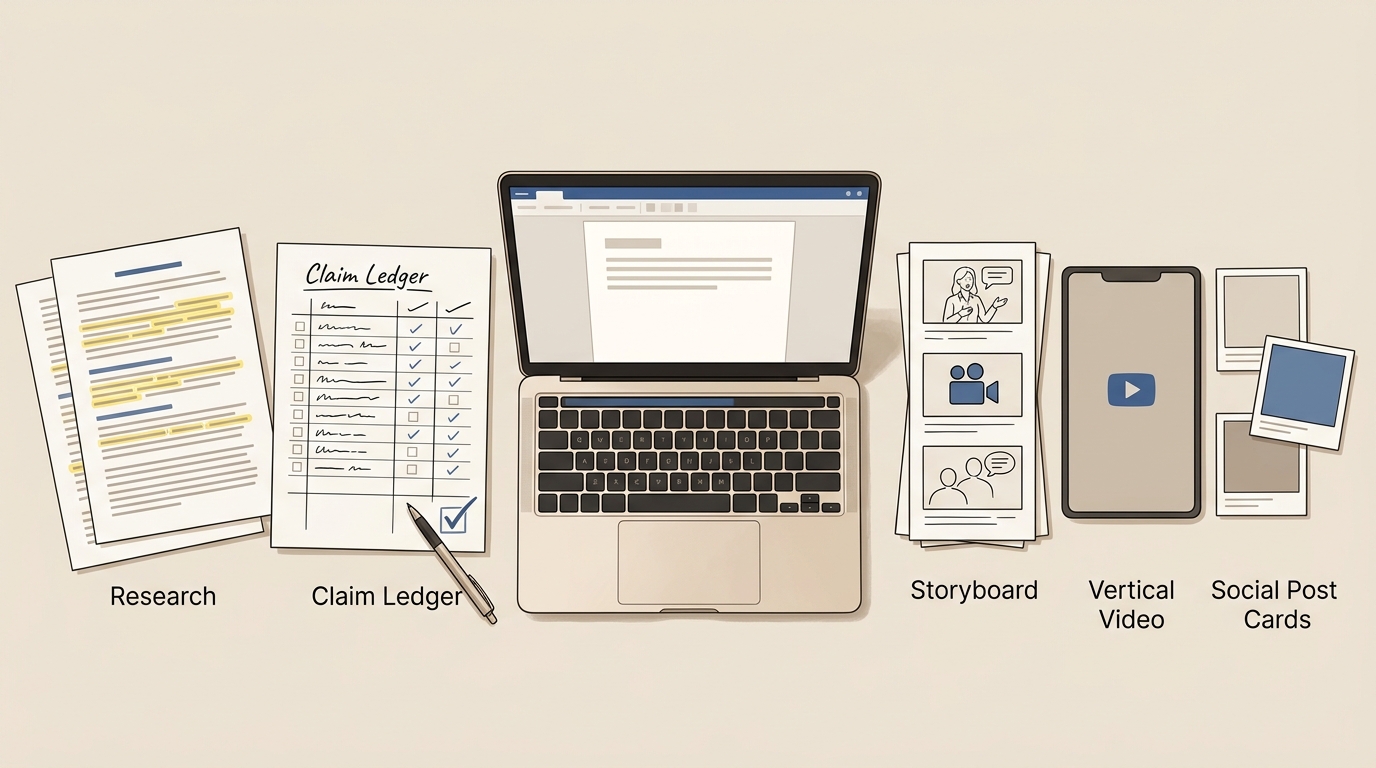
How to Build a Source-Backed AI Content Workflow for Search and Social
A source-backed AI content workflow connects important claims in an article, video, or social post to evidence that a person can inspect. AI can help collect material, organize a brief, draft formats, and repurpose approved ideas. A person still needs to decide whether the evidence supports the final wording.
That distinction matters as teams use AI more often while remaining cautious about its accuracy. A 2025 study from KPMG and the University of Melbourne surveyed more than 48,000 people across 47 countries. It found that 66% reported relying on AI output without evaluating its accuracy, while 56% reported making mistakes in their work due to AI. Only 46% said they were willing to trust AI systems.
For a small business, the practical response is not to avoid AI. It is to separate fast production from factual approval. The workflow below helps lean teams turn one research base into an article, short-form videos, and social posts while keeping the evidence visible and the editorial decision human.
Why source-backed content needs a workflow
A prompt is not a workflow. Nor is copying an AI answer into a document, checking that it sounds plausible, and scheduling it across several channels.
A reliable process should answer these questions:
- Where did each important claim come from?
- Does the source support the exact wording, or only a narrower statement?
- How current is the information?
- Is the statement a verified fact, an interpretation, an example, or an opinion?
- Who approves it before publication?
- What happens when the article becomes a video or a caption?
Without those controls, one questionable statistic can become a blog claim, a video hook, a carousel headline, and several scheduled posts. Repurposing increases the reach of the original mistake.
A source-backed process uses the research as a shared foundation. Each format inherits its factual boundaries from an approved brief rather than from a fresh, open-ended generation request.
The source-backed AI content workflow at a glance
Use this sequence as a starting point:
- Define the audience question and intended action.
- Build an evidence brief from suitable sources.
- Record material claims in a claim ledger.
- Draft from approved evidence.
- Structure the article for readers and retrieval systems.
- Create a format-neutral message map.
- Adapt approved points into video and social assets.
- Review the evidence, editorial quality, and format.
- Publish with useful attribution.
- Measure results and update the source material.
The tools can change. The evidence boundary and approval step should remain.
1. Begin with a decision, not a keyword
A primary keyword defines a search topic, but it does not tell you what the reader needs to decide.
Start the brief with four fields:
| Field | Example |
|---|---|
| Audience | Local service business with a two-person marketing team |
| Problem | Publishing consistently without spreading unsupported claims |
| Decision | Whether to adopt an integrated AI-assisted workflow |
| Next action | Build a pilot workflow for one article and three short videos |
Then write the editorial promise:
This guide will show a lean marketing team how to turn verified research into an article, short-form videos, and social posts while preserving a human approval step.
A section that does not help fulfill that promise belongs in another piece.
2. Build an evidence brief before requesting a draft
Do not begin with, “Write a comprehensive article about AI marketing.” That gives the model room to fill gaps with generic language or facts from unclear sources.
Build a bounded source set first. A useful hierarchy is:
- Laws, regulations, official policies, and platform documentation
- Original research and published datasets
- Company documentation for claims about that company’s product
- Reputable reporting with named sources
- Expert or practitioner analysis
- Community discussion and anecdotal observations
The appropriate source depends on the claim. A software vendor can confirm that its feature exists. It is not independent proof that the feature will increase revenue. A user discussion can reveal recurring frustrations, but it cannot establish a universal performance benchmark.
For each source, capture:
- Publisher
- Page title
- Direct URL
- Publication or update date, if available
- Relevant passage or data point
- What the source supports
- What it does not support
- Commercial interest or methodological limitation
That final field often determines how carefully the claim should be worded.
3. Create a claim ledger
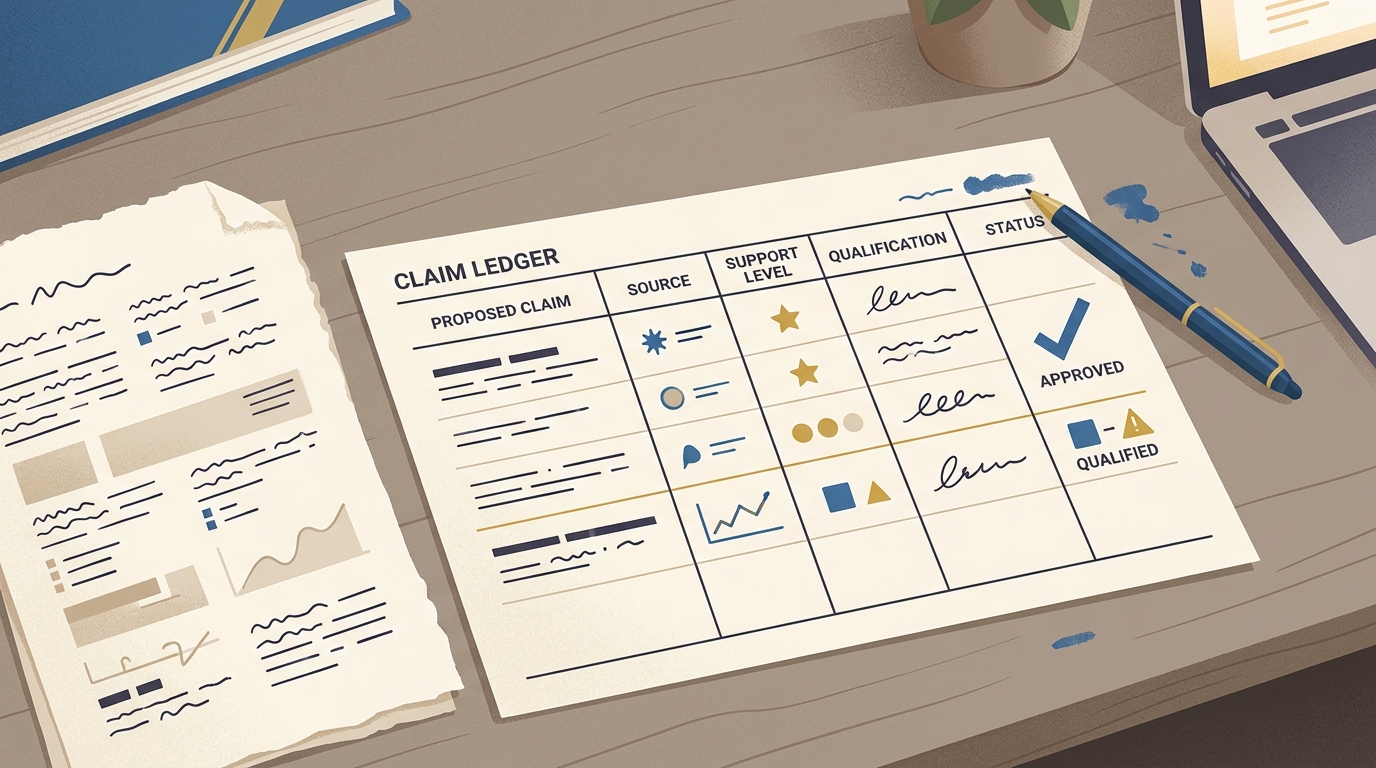
A source library records what you have read. A claim ledger records what you are prepared to publish.
Use one row per material claim:
| Proposed claim | Source | Support level | Qualification | Status |
|---|---|---|---|---|
| AI use is widespread, but trust remains limited | KPMG study | Direct | Findings reflect the study population and methodology | Approved |
| Clear answer blocks may make content easier for retrieval systems to interpret | Practitioner guidance | Indirect | No citation is guaranteed | Qualified |
| A product automatically increases social reach | None | Unsupported | Performance depends on many factors | Reject |
A material claim could affect a reader’s decision, understanding, money, reputation, or behavior. It includes statistics, dates, prices, product capabilities, legal requirements, platform rules, comparisons, and claims about likely results.
Assign each claim one of four labels:
- Directly supported: The source clearly supports the wording.
- Supported with qualification: The basic point is supported, but its scope or certainty needs to be narrowed.
- Inference: The conclusion is reasonable, but the source does not state it directly.
- Unsupported: No adequate evidence has been found.
Use AI to compare a draft claim with a supplied passage. A reviewer who has opened and read the source should make the final classification.
Match the size of the claim to the evidence
If a platform documents that it can extract themes from an article and match them with media, you can describe that capability and attribute it to the platform.
You cannot turn that capability into claims such as:
- “This will triple content output.”
- “This produces professional videos without editing.”
- “This increases reach on every social platform.”
Those are separate performance claims requiring separate evidence. Let the evidence determine the wording.
4. Draft from an approved evidence packet
Once the claim ledger is ready, give the AI a constrained drafting packet rather than an undefined topic.
The packet should include:
- Audience and editorial promise
- Approved sources
- Approved and qualified claims
- Brand voice guidance
- Required disclaimers
- Claims the draft must avoid
- Desired format and call to action
A useful instruction is:
Draft the section using only the approved claims below. Distinguish verified findings from recommendations. Preserve qualifications. If the evidence does not answer a question, mark the gap instead of completing it from general knowledge.
This will not eliminate errors, but it gives the model a defined evidence boundary. After drafting, run a separate claim-extraction pass. Ask the AI to list every factual statement a reader could verify, compare the list with the ledger, and manually inspect the source links.
Do not ask the same model to grade its own accuracy without source comparison. A confident explanation is not evidence.
5. Structure articles for humans and AI search
Content prepared for AI-assisted search still needs the foundations of useful web publishing: a clear question, an accurate answer, accessible pages, descriptive headings, original value, and credible sourcing.
Practitioner guidance on generative search commonly recommends concise answer blocks, self-contained sections, and explicit attribution. These practices may make passages easier to interpret and extract. They do not guarantee inclusion in Google AI Overviews, ChatGPT, Perplexity, or another answer system. Retrieval methods change, and major systems do not publish a formula that guarantees citations.
Use the following structure without turning the page into a series of robotic snippets.
Answer the section question early
Give the reader a direct answer near the start of the section. Follow it with context, evidence, limitations, and examples.
Use descriptive headings
“Build a claim ledger” tells the reader what the section contains. It is more useful than “Step three.”
Keep attribution close to the claim
Link the organization or study when introducing a statistic. A distant source list should not be the only indication of which reference supports a statement.
Make sections understandable on their own
A reader arriving at a subsection from search should understand the basic point without reading the entire article first.
Show uncertainty where it exists
“The study found,” “the vendor documents,” and “this suggests” communicate different evidence levels. Keep those distinctions visible.
Add original utility
Templates, decision criteria, worked examples, and documented analysis give the page a reason to be selected instead of merely rewriting existing articles.
6. Create a format-neutral message map
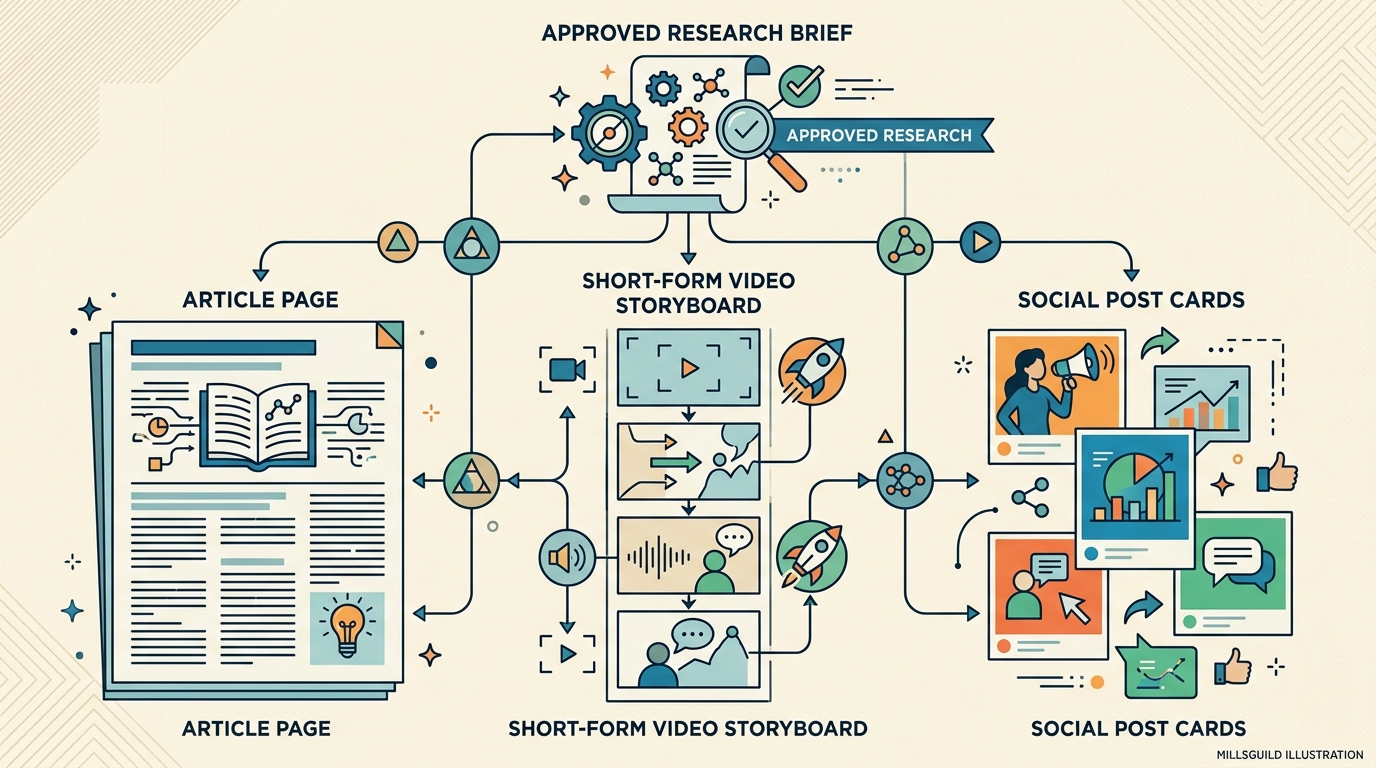
Do not send a complete article directly into a video generator and accept the first summary. Articles, narrated videos, carousels, and captions organize information differently.
First, reduce the approved article to a message map:
| Message element | Purpose |
|---|---|
| Audience problem | Establish relevance |
| Core answer | State the main takeaway |
| Supporting proof | Ground the answer in evidence |
| Practical example | Make the advice concrete |
| Limitation | Prevent overstatement |
| Next step | Give the audience a useful action |
The map becomes the controlled bridge between research and production.
For example, a short video might focus on one mistake from the claim-ledger process:
Hook: One unchecked statistic can spread into every format you publish.
Explanation: When a blog becomes a Reel, carousel, and caption, each asset inherits the original claim.
Action: Record the claim, source, date, supporting passage, and limitation before drafting.
Qualification: Use AI to organize this information, then have a reviewer open the source and approve the final wording.
The pacing changes. The evidence does not.
7. Turn approved research into video assets
AI video production is more manageable as an assembly process than as a single text-to-video request. An Ability.ai workflow guide describes a controlled process involving visual references, storyboarding, asset generation, audio, and timeline editing. That is a production methodology, not proof that one method will work for every team.
For a source-backed blog-to-video workflow, use these stages:
Select one idea per video
A short video rarely needs the entire article. Choose one question, mistake, example, or process step.
Write for speech
Replace long sentences and nested qualifications with natural narration, while keeping the qualification that affects meaning.
Article wording:
The KPMG and University of Melbourne study surveyed more than 48,000 people across 47 countries and found that 56% reported making mistakes in their work due to AI use.
Spoken wording:
In a 2025 global study, 56% of respondents reported making mistakes in their work due to AI use. That is one reason to keep a human approval step in the publishing process.
The video description or accompanying article can provide the full source link.
Build a shot plan
For each line, specify what the audience should see, such as a presenter, product interface, source headline, chart, process diagram, licensed footage, or brand graphic. Avoid unrelated stock footage selected only because it matches a keyword.
Check generated media
Review faces, hands, logos, on-screen text, charts, product interfaces, and implied events. If a visual appears to show a real person, place, product result, or historical event, make sure it is not misleading. Label illustrative media where context requires it.
Edit on a timeline
Automated assembly can create a first cut. A person should check pacing, caption accuracy, visual continuity, pronunciation, source presentation, and the call to action.
Lumen5 describes its platform as able to help turn written content into video scripts and match scenes with media. That can reduce repetitive assembly work. The selected media and the way the source was summarized still require inspection.
8. Adapt the message for social without detaching it from evidence
Short social formats often lose qualifications because absolute language attracts attention. A sourced article can therefore become an unsupported caption during repurposing.
For each derivative asset, preserve:
- The approved core claim
- The relevant source or attribution
- Any limitation that changes the meaning
- A path to the full context
A caption does not always need a formal citation block. It should identify the source when it relies on a study, statistic, policy, or third-party finding. Link to the full article or source where the platform allows it.
Treat hooks as claims too. “Most businesses are wasting money on AI tools” requires evidence. “Disconnected tools can create duplicate work and context loss” can be presented as an operational risk and supported with a concrete example.
Automation can handle formatting and routing. If a scheduler changes a number, comparison, quotation, or degree of certainty, send the variant back for approval.
9. Add three review gates
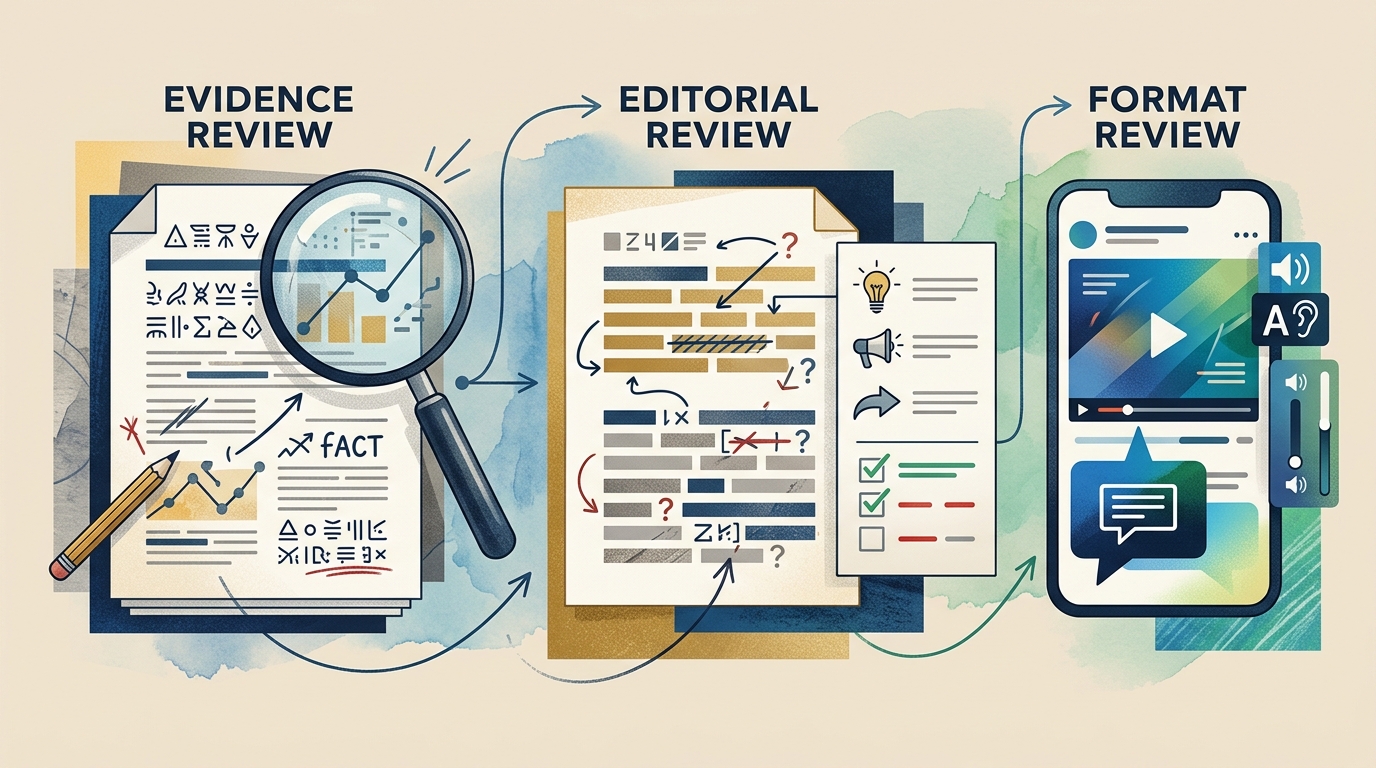
Separate review into three jobs so that factual accuracy does not get lost inside a general “looks good” check.
Evidence review
Open the source and check names, numbers, dates, quotations, source type, wording, currency, and commercial interests. Confirm whether newer information supersedes the source.
Editorial and brand review
Check usefulness, clarity, reading flow, voice, qualifications, original contribution, and the accuracy of the call to action.
Format and platform review
Check captions, subtitles, aspect ratio, safe zones, links, accessibility, visual rights, brand assets, and whether shortening changed the meaning.
A solo operator can perform all three reviews. The value comes from changing review modes, not from having three employees.
10. Publish a source trail readers can use
Attribution should help readers inspect evidence without making the page difficult to read.
Use direct links near important claims, then include a concise source list for the main references. Link to the original study or documentation rather than a search results page or an AI-generated summary.
For video, put the key source in the description, accompanying post, or linked article. If a statistic appears on screen, include the publisher and year in readable text when space permits.
Keep the internal claim ledger even if it is not public. It becomes an update map when a platform changes a feature, a study is replaced, or an old statistic needs to be removed.
11. Build a learning loop instead of an output queue
A content workflow is not complete when an asset is scheduled. Record what happened and use it to shape the next research brief.
Track signals that match the asset’s purpose:
- Search impressions and qualified visits for an explanatory article
- Watch behavior and completion patterns for video
- Saves, substantive comments, and relevant clicks for educational social posts
- Leads or product actions when conversion is the goal
- Corrections, questions, and objections that expose evidence gaps
One high-view post does not prove that a topic or format will always work. Compare patterns across several pieces and preserve context such as channel, audience, subject, format, and publishing date.
If your workspace includes a Growth Copilot, treat its performance suggestions as hypotheses to investigate, not as established conclusions. A person still decides whether a recommendation fits the brand, audience, available evidence, and business objective.
An integrated workspace can reduce the need to rebuild approved context across separate research, writing, video, publishing, and measurement tools. The benefit is continuity. The human operator still reviews sources, shapes the message, approves assets, and learns from published work.
A reusable source-backed content checklist
Before research
- Define the audience, question, decision, and intended action.
- Write the editorial promise.
- Identify claims likely to require current or authoritative sources.
During research
- Prefer primary and authoritative sources.
- Capture direct URLs, dates, and supporting passages.
- Record what each source cannot establish.
- Separate company documentation from independent evidence.
Before drafting
- Approve, qualify, or reject each material claim.
- Give the AI a bounded evidence packet.
- Include brand rules, disclaimers, and prohibited claims.
Before repurposing
- Create a format-neutral message map.
- Select one core idea for each short video or post.
- Preserve attribution and meaningful qualifications.
Before publishing
- Open and inspect every important source.
- Check numbers, dates, names, links, captions, and visuals.
- Confirm that platform-specific edits have not changed the claim.
- Make the next action clear and accurate.
After publishing
- Measure results against the asset’s purpose.
- Record audience questions and corrections.
- Update the source brief when information changes.
- Use recommendations as hypotheses rather than automatic instructions.
Frequently asked questions
What is source-backed AI content?
Source-backed AI content is created from an evidence set that editors can inspect. Important claims connect to original research, official documentation, platform policies, or other appropriate sources. The system may summarize and draft, while a person verifies the source and approves the final wording.
Can AI fact-check its own content?
AI can extract claims, compare wording with supplied passages, and flag possible inconsistencies. It can also miss errors or defend an unsupported statement. A reviewer should open the cited source and verify material claims before publication.
Does source-backed content guarantee visibility in AI search?
No. Clear structure, direct answers, useful attribution, and credible evidence may make content easier to understand and retrieve, but no workflow guarantees a citation or ranking in an AI-generated answer.
How do you turn a sourced article into a short video?
Start with an approved message map rather than asking a video tool to summarize the entire article. Select one idea, rewrite it for speech, preserve the relevant qualification, plan the visuals, assemble a first cut, and review the script, captions, source references, and media before publishing.
Which claims require the most careful review?
Prioritize statistics, prices, dates, quotations, legal or policy statements, health and financial information, product comparisons, platform capabilities, and claims about expected performance. Review any statement that could materially affect a reader’s decision.
Put the workflow into practice
Start with one useful topic. Build its evidence brief, approve the claims, produce the article, and create a small set of derivative videos and posts. The pilot will show where your team loses context, repeats work, or needs a stronger review gate.
If you want research, creation, short-form video, publishing, and performance recommendations in a more connected workspace, start creating with MG Social Studio.
Results vary. AI-generated recommendations and content should be reviewed before publishing.